

The new sharering.network is live. It carries a new brand and plainer words, every product page has been rebuilt, and it arrives with ShareRing Me V3, the rebuilt version of our identity wallet, which is now on the App Store and Google Play.
I built the new site alongside V3 because the two describe the same system from opposite ends. ShareRing Me is what a person holds on their phone, ShareRing Link is what a business builds to ask that person a question, and ShareLedger is the chain underneath that proves the check happened.
The old site explained the technology, but you had to work to find out what a check does, what the customer sees and what it costs. The new one starts from what a business is buying, which is a verified answer about a customer rather than a copy of their documents, and shows what the customer does on their phone and what each check costs.
Why we rebuilt the website.
Most people come to our site with a specific job to do. A venue needs to know a guest is over 18, an exchange needs to onboard a customer under AML rules, and a bank wants to stop asking customers for the same documents every time they open something new. The new site is organised around those jobs, so each industry page opens on the check that sector needs, shows the ShareRing Link workflow that runs it and what the customer does in ShareRing Me, and puts the price beside it.
We also wrote every claim so that it means exactly what it says. Our flows are built to GDPR, and the site says “built to” because nobody issues a GDPR certificate. They are built to Australia’s AML/CTF requirements, and the site states that ShareRing is not registered, enrolled or accredited by AUSTRAC.
Six products, one identity underneath.
The home page lays out the product suite in one place. ShareRing Me is the mobile identity wallet, where a person verifies once, keeps the credential in a vault only they can open and proves things from it without handing the document over. ShareRing Link is the no-code verification portal, where a business builds a workflow once, publishes it as a QR code or an embedded iframe and gets a result rather than a document.
ShareLedger is the identity chain underneath, recording that a check happened and passed with no personal document on it. Me Modules are the mini apps that run inside ShareRing Me, ShareRing Prove is the offline side of ShareRing Me that arrives in an update to the app, and DigitalMe, our private AI agent, now has its own page and waitlist.
ShareRing Me V3 is live.
V3 is a complete rebuild of the app, with a redesigned interface and a new foundation for the features we have planned over the next year. If you already use ShareRing Me, update it from the App Store or Google Play and everything stays where it was: your vault, your accounts and your documents carry over, and there is no fresh install. V3 runs on phones, tablets and foldables.
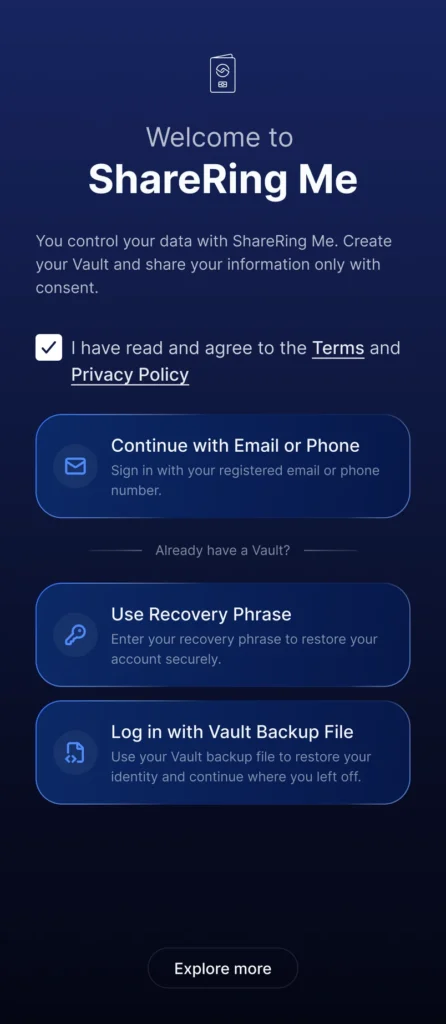
New users can sign up with an email address or a phone number. Returning users can log in with a ShareRing passphrase, a passphrase created on another platform or a vault backup file, and they can also get back in without a passphrase at all: ShareRing Me uses facial recognition to confirm it is them and restores their vault from their own cloud drive.
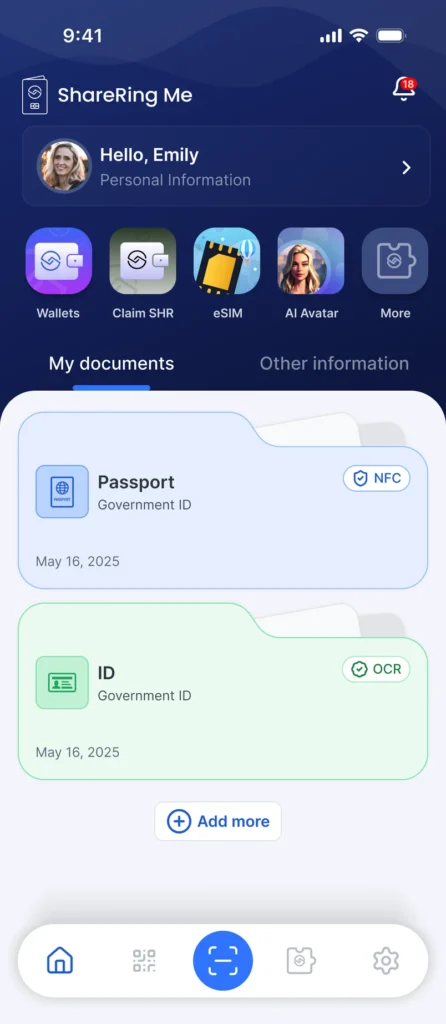
The vault has been rebuilt around government IDs, other documents and other personal information. You can preview each document before you submit it, the photo from your ID becomes your profile picture, and ShareRing Me supports IDs from more than 190 countries and territories, with NFC chip reading on supported ePassports.
Recovery and security now sit together in Settings, where you can back up your vault, import a backup, turn on Cloud Vault sync, view your recovery phrase, change your PIN and manage your security settings. You can remove or delete your account at any time, and the FAQs are built into the app.
V3 also follows the latest standards for interoperability between wallets, issuers and verifiers. It supports OpenID for Verifiable Credential Issuance (OID4VCI) for receiving credentials, OpenID for Verifiable Presentations (OID4VP) for presenting them, SD-JWT VC for credentials that let you disclose only the claims a verifier asks for, and DID resolvers for looking up the decentralised identifiers behind issuers and holders.
How sharing works in V3.
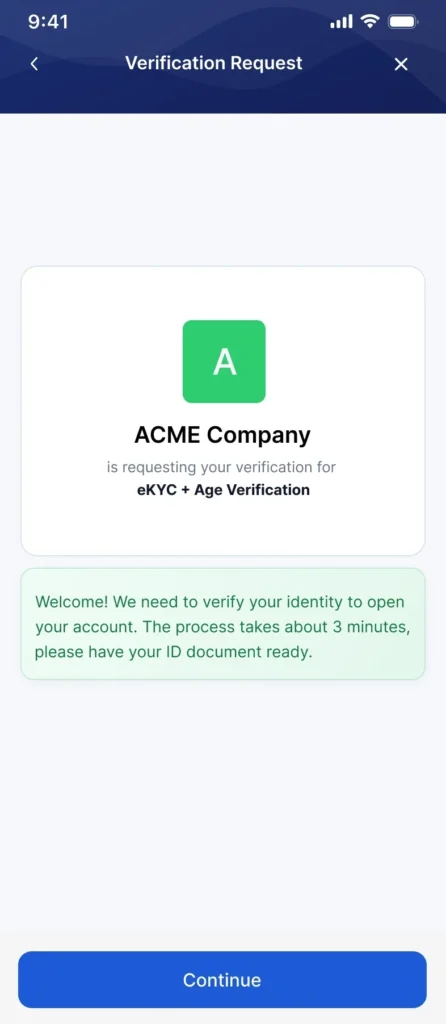
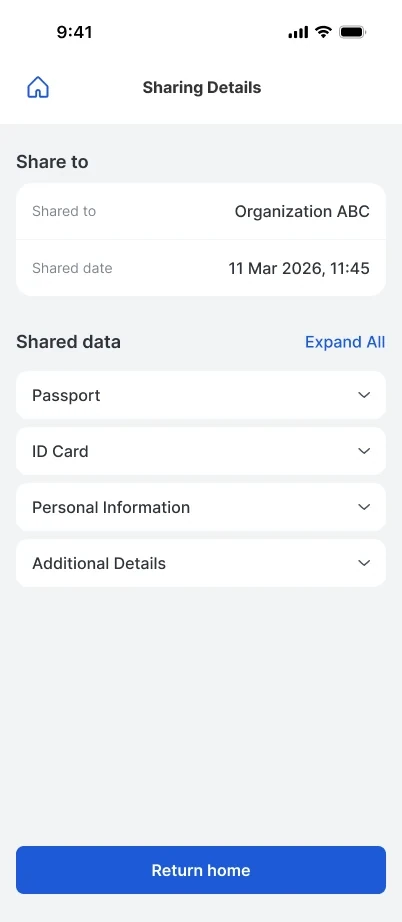
When a business sends you a ShareRing Link request, you scan the QR code and V3 shows you who is asking and exactly what they are asking for before anything leaves your phone. You approve every share in the app, you get a clear result once it is done, and the Sharing Details screen keeps a record of who you shared with, when, and what.
V3 supports selective disclosure, so at a bottle shop or a venue door you can prove you are over 18 without showing your date of birth, and a region-locked service can confirm your country without seeing your address. Checking in after a flight, you share the one passport, ID card or driver licence you choose, and signing up for something new can mean sharing your name and email address and nothing else.
ShareRing Link, and pricing you can read.
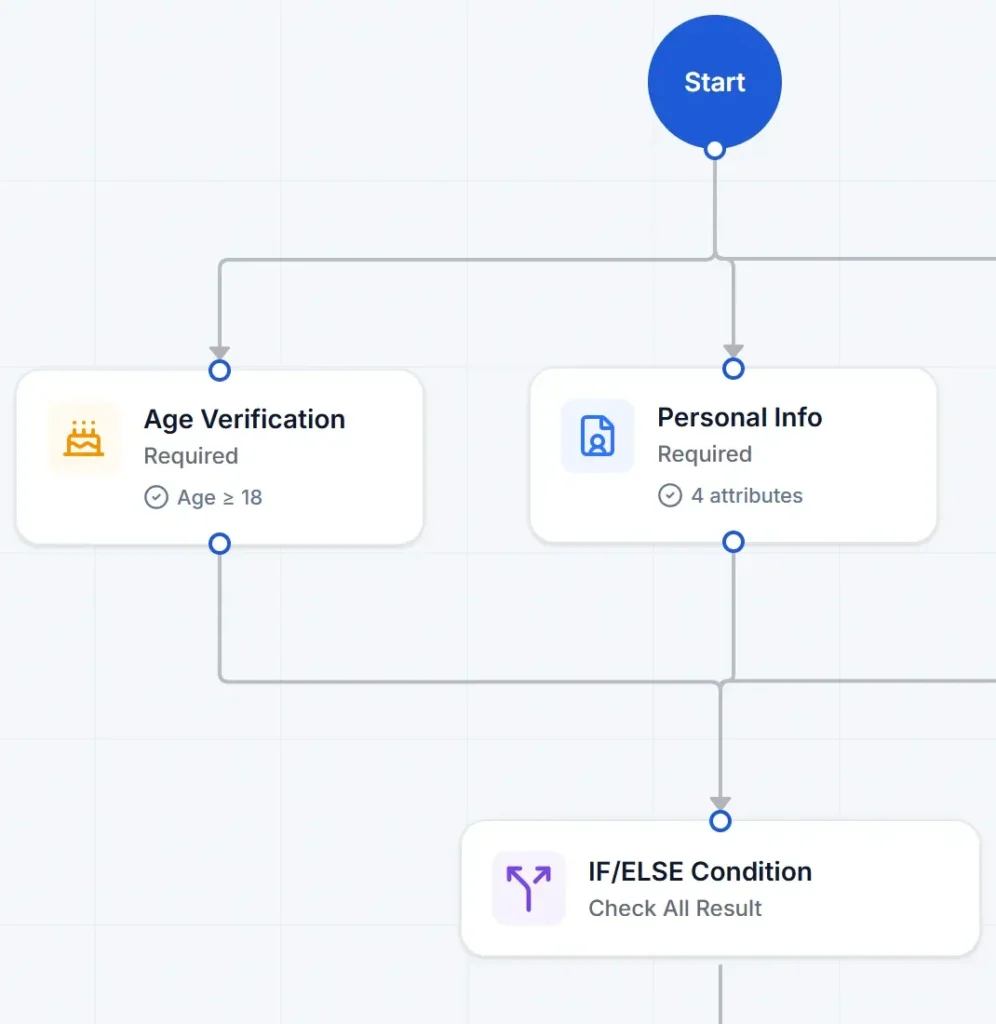
ShareRing Link is where a business builds its checks. KYC, age and AML flows are put together in the browser from 13 drag-and-drop task types, including KYC verification with OCR, NFC and facial recognition, liveness checks, global watchlist screening for AML, PEP and sanctions, IF/ELSE branches on any result, and webhook delivery.
A published workflow becomes a static QR code or an embeddable iframe, so the same check works on a kiosk, on a standee at the door, on a website or through the API, and every scan starts its own verification run. Results arrive by signed webhook with HMAC-SHA256 verification, and a business can put its own logo, banner and badge on the screens its customers see. Customers complete the check in ShareRing Me or in the Seamless web app without downloading anything, and someone already verified for one organisation can share that verification with the next without going through KYC again.
The prices are on the site rather than behind a sales call. ShareRing Link is pay as you go, charged per verification, with no subscription, no monthly minimum and no lock-in contract.
An age check is US$0.45 and a returning age proof is free, one-document KYC is US$0.85, a global watchlist check is US$0.60 and motion authentication is US$0.20, and every new account starts with a 14 day free trial and 10 verifications on us. The new pricing page starts from who you are verifying, whether that is a guest at a door, a shopper at an age-restricted checkout, a traveller at check-in or a new bank customer, and shows the price, what the customer does and the workflow behind it.
Me Modules, for users and developers.
Me Modules are mini apps that run inside ShareRing Me, connected to your verified identity and your wallet. In V3 they include Wallets, where you manage your ShareToken, staking and swapping, along with Claim SHR, eSIM data plans for travel, AI Avatar and NFTs. The modules and the wallet ship as their own bundle, so we can update them without waiting on an app store release.
For developers, a Me Module is a web app that runs inside ShareRing Me and talks to it through a privacy-first event protocol, with more than 20 event types across the vault, the wallet, cryptography, and Apple Wallet and Google Wallet passes. A module only receives the verified attributes the user chooses to share for that interaction.
You build it with standard web tools, host it on a domain you control and submit it to ShareRing, and once it is approved it appears inside ShareRing Me for the users you target. The documentation is at docs.sharering.network.
ShareLedger, in the open.
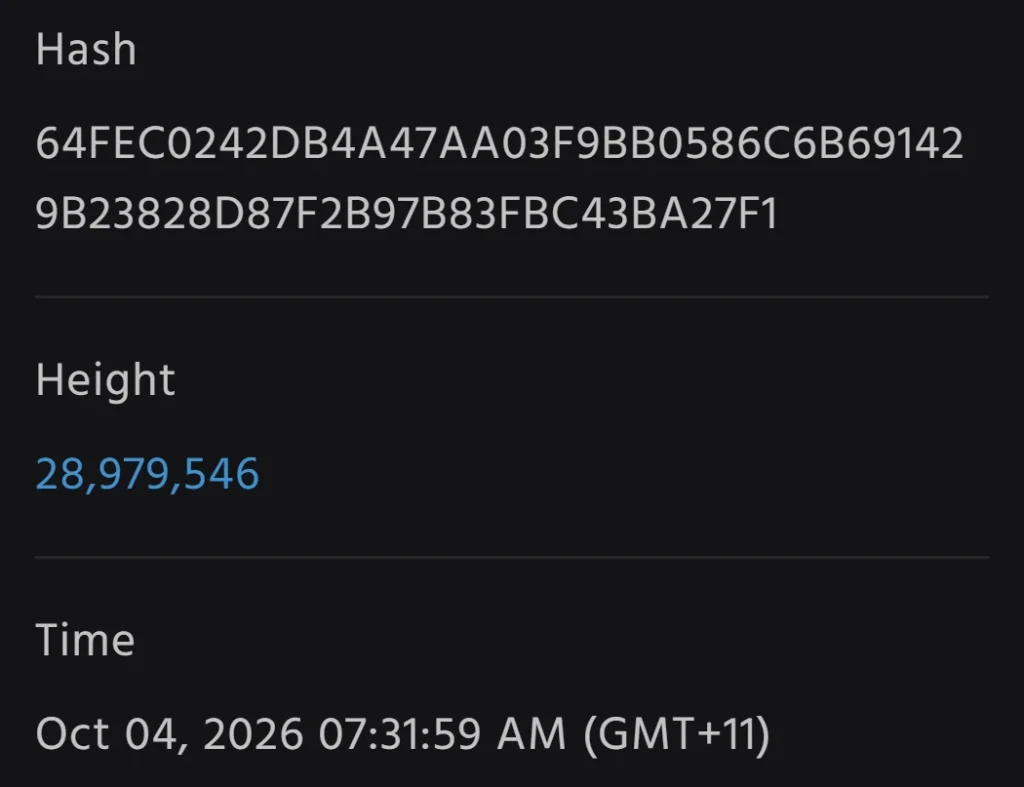
ShareLedger now has its own page, built around the public block explorer. Anyone can audit block production, the validator set, the fee on every transaction and the governance record without an account, an API key or our permission.
Alongside the standard Cosmos modules, ShareLedger runs six of ShareRing’s own for identity: id, document, asset, booking, electoral and gentlemint. The active validator set is capped at 100, and all seven governance proposals have gone to a vote and passed, including the upgrade that brought CosmWasm smart contracts to the chain and the change that made IBC possible.
The busiest contract on the chain has been executed more than 22 million times. ShareLedger never stores personal data: it records tamper-evident hashes and consent receipts, and the credentials themselves stay in ShareRing Me on the user’s device.
Industries, evidence and partners.
The industry pages now cover twelve sectors, from banking, finance and crypto exchanges to ecommerce, nightlife, travel, and dating, creator and adult platforms. Two age assurance pages set out what the rules require in the United Kingdom and Australia, the two markets with a named regulator, a published standard and a public enforcement record, with the sources linked so you can check them yourself.
The compare page sets an age estimate, a document upload and a held credential side by side. It also notes that ShareRing was one of around 60 providers in the Australian Government’s Age Assurance Technology Trial, with our deployment running in April 2025.
The case studies page now lists nine deployments, from a national postal service to an Australian school. The first is Thailand Post, where ShareRing powers Prompt Pass, the verifiable credential wallet inside the Prompt Post app, delivered with TKC and Transformational.
The new partnerships page explains how that work was divided and how technology partners and credential issuers can build with us. The Prompt Pass roadmap moves into a network of Thai universities later in 2026.
What is coming next.
ShareRing Prove.
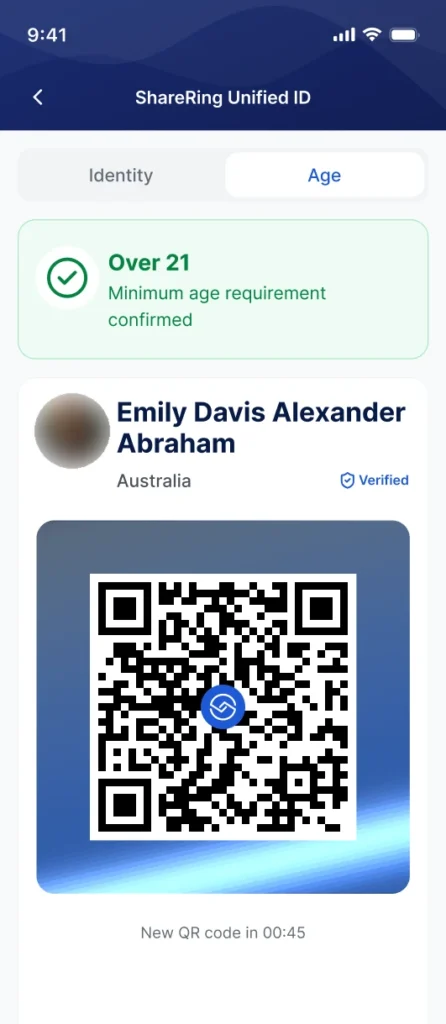
ShareRing Prove, redesigned, arrives in an update to ShareRing Me. It is your offline identity inside the app: you pick the situation you are in, such as buying alcohol or getting into a club, and Prove answers the one question that situation asks, with no signal needed and everything else left in your vault.
It sits on a new ShareRing Unified ID screen with Identity and Age tabs and a QR code that refreshes. It is a feature of ShareRing Me rather than a separate app.
Human Pass.
Human Pass is coming to ShareRing Me, and you will mint your Human Pass in the app. We will share more about it closer to launch.
Payments and store plugins.
Payments inside Me Modules are also on the way. For online stores, where age verification at the checkout already runs through the seamless SDK, dedicated plugins for Shopify and WordPress are coming soon.
DigitalMe.
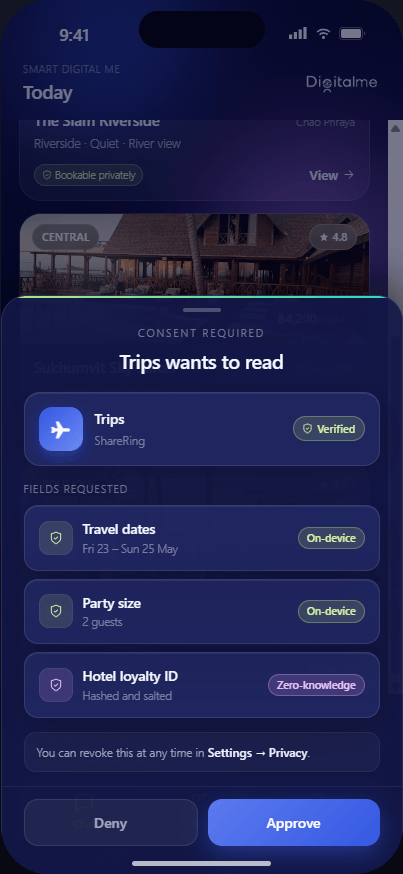
DigitalMe is our private agentic AI assistant, and the waitlist is open on its new page. It is built to book flights, hotels and tables, manage your data and pay in chat, and every action it takes on your behalf comes to you first as a consent sheet you approve or veto.
Your credentials stay in the vault on your device, your identifiers are stripped out before the AI sees a question, and your history lives on your own private stack rather than in a shared database. It launches with 13 skills, with third-party skill publishing to follow. The proof of concept is live and the MVP is next, and the technical whitepaper and briefing overview are on the site.
Where to start.
If you use ShareRing Me, update it from the App Store or Google Play. If you have not used it before, download it, sign up with your email or phone number and add your first document.
If you run a business that needs to verify customers, staff or members, build your first workflow in ShareRing Link on the free trial, and if you want to be among the first to use DigitalMe, join the waitlist. Everything else is at sharering.network, or you can book a demo.
Frequently asked questions.
What is new on sharering.network?
The site has a new brand and plainer copy, rebuilt pages for ShareRing Me, ShareRing Link, ShareLedger, Me Modules, ShareRing Prove and DigitalMe, per-check pricing organised by who you are verifying, industry pages for twelve sectors, age assurance pages for the United Kingdom and Australia, a compare page, nine case studies and a new partnerships page.
Is ShareRing Me V3 available now?
Yes. ShareRing Me V3 is on the App Store and Google Play. If you already use ShareRing Me, update the app and your vault, accounts and documents stay in place, with no fresh install.
What is new in ShareRing Me V3?
V3 has a redesigned interface, sign-up with an email address or phone number, log-in with a ShareRing passphrase, a passphrase from another platform, a vault backup file or facial recognition that restores your vault from your own cloud drive, a rebuilt vault with document preview, vault backup, import and Cloud Vault sync, a before-sharing screen and Sharing Details history, support for tablets and foldables, and the OID4VCI, OID4VP, SD-JWT VC and DID resolver standards for interoperability.
How much does ShareRing Link cost?
ShareRing Link is pay as you go with no subscription, monthly minimum or lock-in. An age check is US$0.45 and a returning age proof is free, one-document KYC is US$0.85, a global watchlist check is US$0.60 and motion authentication is US$0.20. New accounts start with a 14 day free trial and 10 free verifications.
What is ShareRing Prove and when can I use it?
ShareRing Prove is offline, scenario-based identity inside ShareRing Me. You choose the situation, such as buying alcohol, and it proves only what that situation asks, with no connection needed. It arrives in an update to ShareRing Me.
What is DigitalMe?
DigitalMe is ShareRing’s private agentic AI assistant. Your credentials stay in the vault on your device, your history stays on your own private stack, and every action needs your consent. The waitlist is open at sharering.network.
By Rohan Le Page, Founder and Co-CEO of ShareRing
#ShareRing #ShareRingMe #ShareRingLink #ShareLedger #DigitalIdentity #SelfSovereignIdentity #PrivacyKYC #Private #Secure #Verified