

ShareRing Solutions launched today at sharering.solutions. It gives Australian accountants, real estate agencies and bookmakers a ready-made AML/CTF portal for checking their customers. Each business gets a workspace on its own web address, the customer completes the check on their own phone, and the result comes back with a risk rating and the reasons for it.
Since 1 July 2026, accountants and real estate agents have been covered by Australia’s AML/CTF law for the designated services they provide, and bookmakers were already reporting entities before that date. A lot of businesses are now working out how to identify a client, weigh the risk and keep the evidence, often with a photocopier, an email inbox and a shared drive. ShareRing Solutions is built for that job, with one product for each of the three industries.
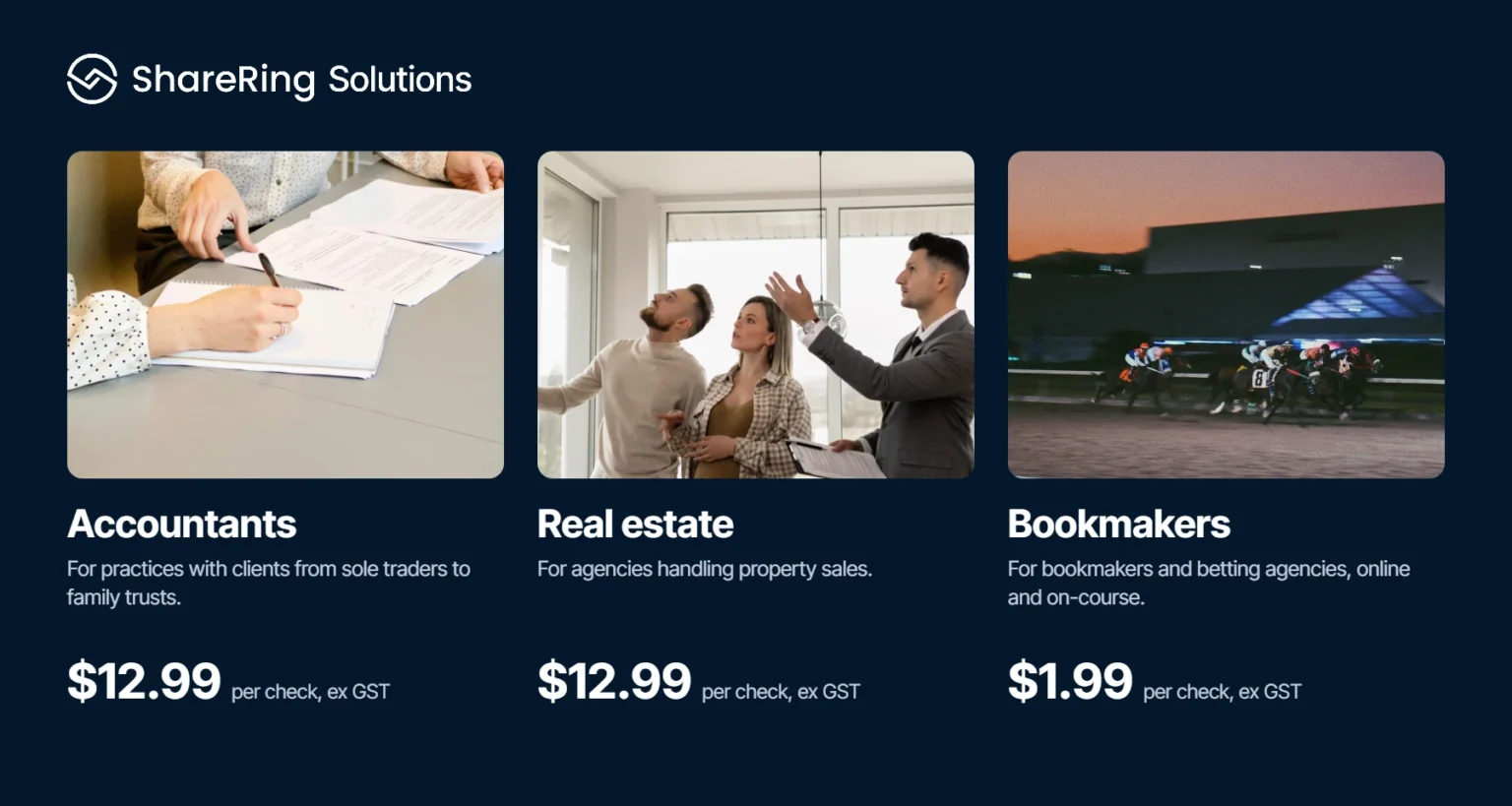
Each product has its own published price: $12.99 per check for accountants, $12.99 per check for real estate agencies and $1.99 per check for bookmakers, all ex GST. There is no monthly fee and no setup fee, and every account starts in a free sandbox with sample clients, so a business can run the whole workflow before a real client is involved.
Why we built ShareRing Solutions.
ShareRing Link is our no-code verification platform. A business builds a workflow on a canvas from drag-and-drop tasks, publishes it as a QR code or an embedded iframe, and gets a verified result rather than a copy of a document. That works well for a bank, an exchange or a venue group with someone whose job is to design onboarding. It is a lot to ask of a small accounting practice or a suburban real estate agency that has only just come under AML/CTF law.
Those businesses need the check their industry requires, already set up, along with the paperwork that follows it. ShareRing Solutions takes ShareRing Link and packages it as a ready-made portal for each industry. The workflow, the checks, the risk rating, the review screen, the report drafts and the record keeping are in place from the first day, so a firm picks its industry, chooses its web address and starts checking clients.
It also replaces the way ID is collected in most of these businesses today, which is photocopied IDs in a drawer, licence photos sent by email, a scan on the shared drive and a lot of chasing for the missing page. With ShareRing Solutions the client scans their own ID on their own phone, the document is checked for forgery and against lost and stolen records, and the result arrives in the business’s workspace with a risk rating and the reasons, ready for sign-off.
What Tranche 2 changed.
The Tranche 2 reforms brought accountants and real estate agents under AML/CTF law for designated services from 1 July 2026, alongside bookmakers, who were already regulated. Before that work starts, the business has to identify its client, assess the risk and keep the evidence.
For accountants, the line is the type of work. Tax returns and BAS on their own are not a designated service, so that work alone does not bring a firm under AUSTRAC. Helping a client buy or sell property, buy or sell a company, create or restructure a company, sell a shelf company or hold money or property as part of a transaction is, and AUSTRAC lists these professional designated services in Table 6 of section 6 of the Act. A firm that provides one enrols with AUSTRAC no later than 28 days after it starts.
For real estate, the line is the sale. An agency that brokers a sale, purchase or transfer of property has two customers for AML/CTF purposes, the vendor and the purchaser, even when it acts for only one side, and buyer’s agents are included as well.
Bookmakers were reporting entities before Tranche 2. Since 29 September 2024, online books have had to verify a customer before the account is opened, and since 31 March 2026 an on-course cash payout or exchange of $5,000 or more has needed customer due diligence, where the line used to be $10,000.
The penalties are set by the Federal Court. A court can order up to 100,000 penalty units against a company for each contravention, which is about $36.4 million, and up to 20,000 penalty units against an individual, which is about $7.28 million. These are maximums, and the penalty unit has been $364 since 1 July 2026.
Three products, one for each industry.
Each industry has its own product, with its own workspace, checks and guide, built around the rules that apply to it.
Accountants.
The accountants product is built for practices with clients from sole traders to family trusts, and costs $12.99 per check, ex GST. The firm adds the client and picks the service it is providing, and the check follows the risk of that service. It checks the client, and the people who own or control it, before a designated service, then records its decision. For a company or trust, the firm lists the beneficial owners and each one gets their own secure link.
Real estate.
The real estate product is built for agencies handling property sales, and costs $12.99 per check, ex GST. The agency creates a sale file and adds the vendor and the purchaser, and each of them gets their own secure link, so there is nothing to print, scan or post. Companies and trusts are covered too, with an entity lookup built in, and the evidence and the decisions stay with the file.
For the person the agency represents, the agency agreement is the usual starting point for the check. For the other party it is generally when the transaction is expected to proceed, which is typically at contract signing. Direct sales by a property-selling business without an independent agent, and conveyancing, have their own separate requirements, and the product does not cover those workflows.
Bookmakers.
The bookmakers product is built for bookmakers and betting agencies, online and on course, and costs $1.99 per check, ex GST. Punters are checked before an account opens, and on course before a payout or exchange of $5,000 or more. The book’s own risk rules decide who needs a check, and the punter’s age is read from the verified date of birth, so 18+ is confirmed from the ID rather than typed in at the counter.
How a check works.
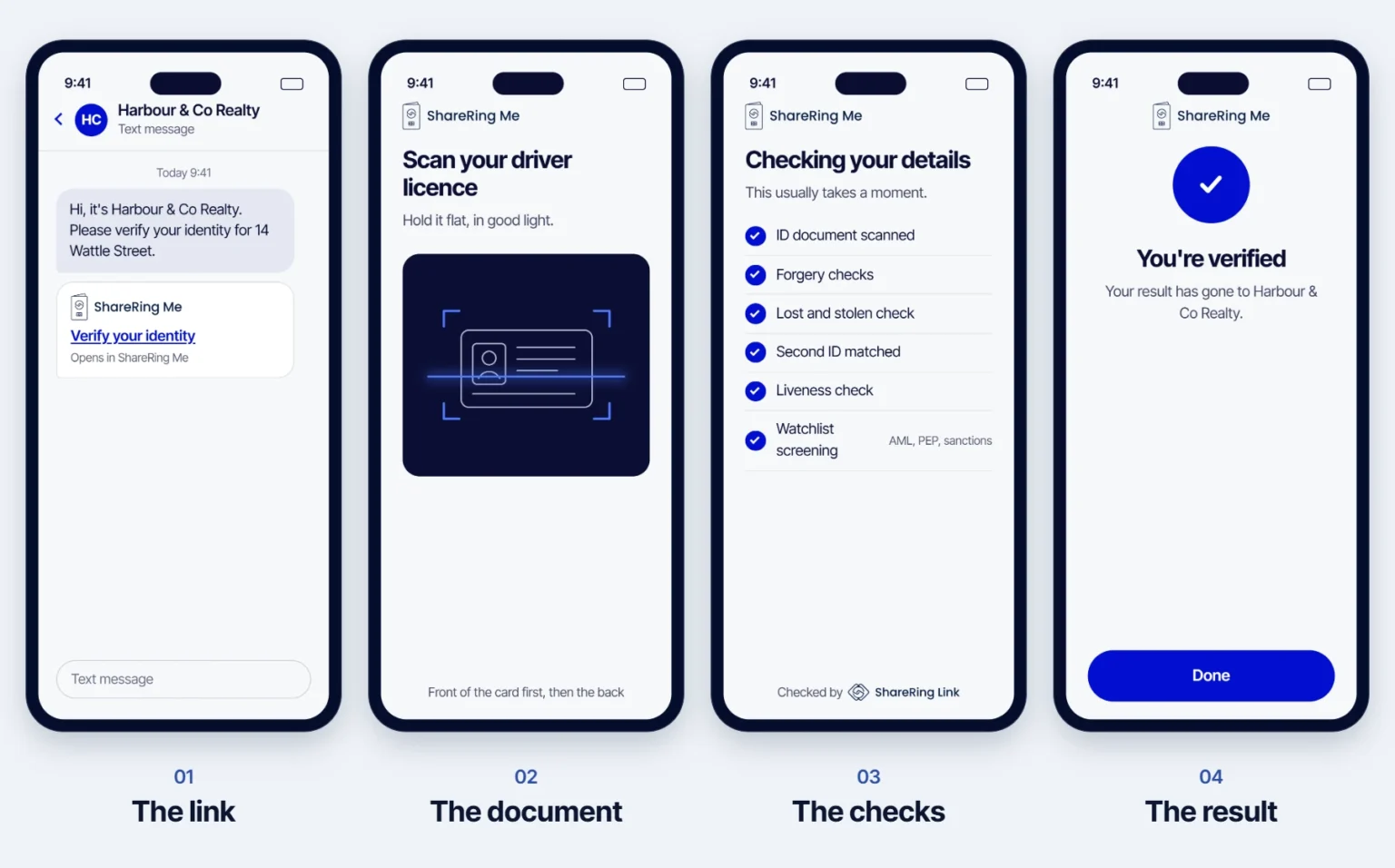
A check in ShareRing Solutions has four steps, and the client does most of the work on their own phone.
It starts with a link. The business sends the client a secure link by email or SMS, or puts a QR code on a desk, a counter or an open-home sign. Either way it opens in ShareRing Me, which shows the client who is asking and why, and nothing is shared until the client agrees.
The client then scans their driver licence or passport with their phone camera, and the document is checked for forgery and against lost and stolen records. Every check matches a second ID to the first, runs a liveness check and screens the client against global AML, PEP and sanctions watchlists, at the same price.
The client sees the result straight away, and so does the business, in its workspace.
A risk rating you can explain.
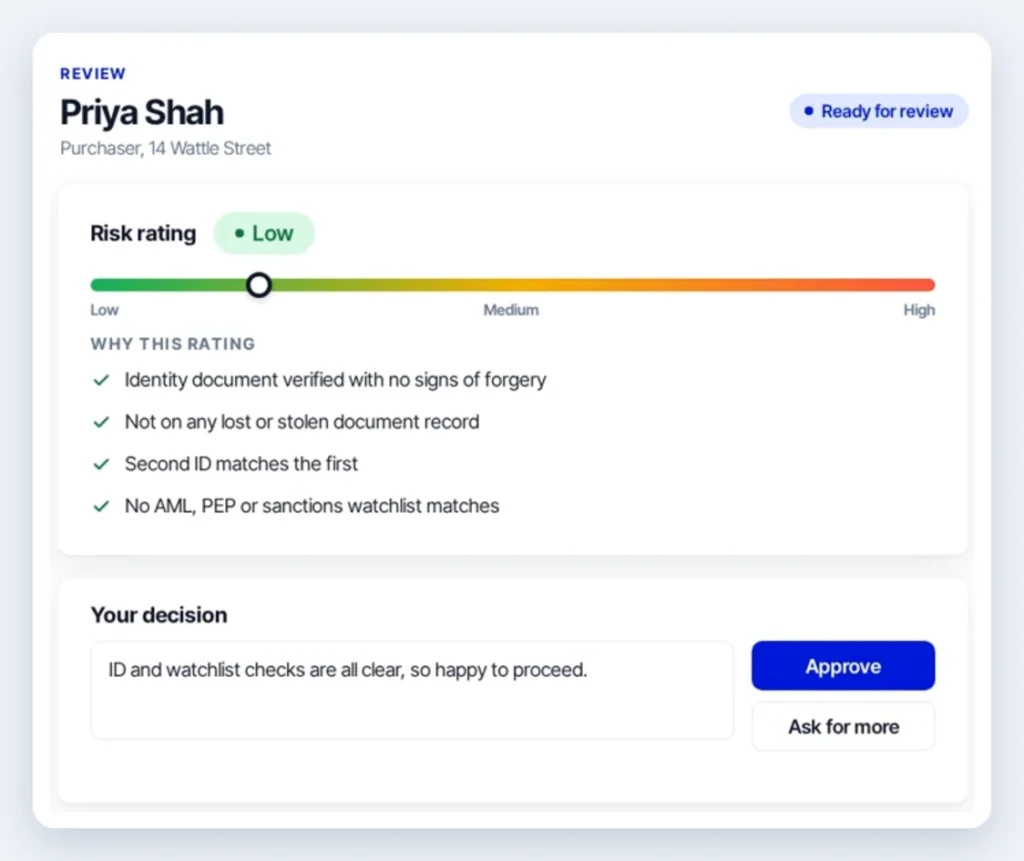
Back at the desk, the review screen shows which checks passed, what the screening found and why the result came out low or high, all in one place. An authorised staff member reads it, makes the call on the client and approves it with a short note, and every step lands in the audit trail.
The decision on each client belongs to the business, and under its AML/CTF program it has to understand who its customer is and record why it went ahead. The review screen puts the evidence, the screening result and the rating together so the reviewer can do that in one place.
What we do, and what stays with you.
ShareRing Solutions does the legwork of a check, and the business makes the calls. AML/CTF stays the business’s obligation, and this is how the work divides for one client, from the link to the file the business keeps.
| Step | ShareRing | You |
|---|---|---|
| Invite | Gives each client their own secure link. | Send the link to your client. |
| Verify | Your client scans their ID on their own phone, and it is checked for forgery and against lost and stolen records. | Nothing to photocopy, email or chase. |
| Rate | Gives the result a risk rating, with the reasons. | Read why it came out low or high. |
| Review | Puts the checks and the reasons on one screen, and logs every step in the audit trail. | Make the call on your client as an authorised staff member, and approve it with a short note. |
| Report | Drafts suspicious matter and threshold transaction reports for you to review and export. | Decide if a report is needed, then review the draft and export it. |
| Lodge | Keeps the report with your client’s file and the audit trail. | Lodge any required reports yourself, in AUSTRAC Online. |
| Keep | Accountants and bookmakers: records go to your own Google Drive or Microsoft 365. Real estate: your own storage is on the way. | Keep CDD records for 7 years after the relationship ends or the transaction completes. |
Throughout, the business keeps its own AML/CTF program, trained staff and controls that suit its services. A passed check is evidence for the file, but it is not the business’s AML/CTF program and it is not proof that a report has been lodged. We do not lodge reports with AUSTRAC on anyone’s behalf.
Reports and deadlines.
When a report is due, the portal drafts it, and the business reviews it, exports it and lodges it in AUSTRAC Online under its own login. Once AUSTRAC issues a receipt, the business records the receipt number against the reviewed draft, so the file shows what was lodged and when. A draft or an export on its own does not establish lodgement.
A suspicious matter report has no dollar minimum. It is due within 24 hours when the suspicion is about terrorism financing and within 3 business days otherwise, and it still applies when the person cannot be identified or walks away. On the bookmakers product, the draft wizard carries a tipping-off warning and suspicious matter reports are restricted to owners and administrators.
A threshold transaction report is about physical cash. A designated service involving $10,000 or more in physical cash, including foreign cash of that value, is reported within 10 business days. An electronic settlement payment or an online card or NPP payout is not physical cash, and splitting cash to stay under the line is a matter for a suspicious matter report rather than a threshold transaction report.
The annual compliance report covers the financial year, and AUSTRAC opens it each year from 1 July to 30 September. The business lodges that in AUSTRAC Online as well.
| What | Deadline |
|---|---|
| Suspicious matter report, terrorism financing | 24 hours from forming the suspicion |
| Suspicious matter report, other | 3 business days after the day the suspicion was formed |
| Threshold transaction report | 10 business days after the day of the cash transaction |
| Update enrolment details | 14 days after something changes |
| First enrolment | 28 days after starting a designated service |
Each product comes with a guide written for its industry at sharering.solutions/guides. The accountant guide works through which services bring a firm under AML/CTF, when to enrol and every reporting deadline. The real estate guide covers who to check on a sale, when the check starts and what to keep on the file. The bookmaker guide sets out the on-course $5,000 check, the $10,000 threshold transaction report and the reports a book lodges, and explains why the two lines are different.
Your records stay in storage you own.
For accountants and bookmakers, we don’t hold your customers’ data. The business connects Google Drive or Microsoft 365 when it sets up its account, and its records go there, including the risk rating and the reasons, the review, the reports and the audit trail. A check passes through our system on its way to the business’s storage, and we don’t keep it.
For real estate, connecting your own storage is on the way.
CDD records are kept for 7 years. For accountants that runs from the end of the client relationship, for real estate from when the sale completes or the relationship ends, and for bookmakers from the end of the punter relationship or after a one-off payout. No personal data goes on-chain.
Setting up a workspace.
Every business gets its own workspace on its own address, your-name.sharering.solutions, and the team signs in there with an email link. A business that forgets its address can find it again from the Find my portal page on sharering.solutions.
Every account starts in a free sandbox with sample clients, simulated checks and the full workflow, and checks in the sandbox are always free. The sandbox uses sample data, so real people should not be entered into it.
When the business is ready for real checks, it tops up prepaid credit and pays per check. The first top-up comes with a bonus: buy $100 of credit and we add another $100, and for bookmakers we add another $25 on the first $25. A check against the government’s Document Verification Service (DVS) is available as an optional add-on, at $0.75 for a single document, $2.00 for a 2+2 check and $2.40 for both, ex GST, and every price is on our pricing page.
Built on ShareRing Link and ShareRing Me.
ShareRing Solutions is powered by ShareRing Link, and the client’s side of every check runs in ShareRing Me, the identity wallet we rebuilt for V3. If you already use ShareRing Link, nothing changes for your account.
ShareRing Solutions is built to the AUSTRAC AML/CTF requirements and built to GDPR. ShareRing is not AUSTRAC registered, enrolled or accredited. It is built under ShareRing’s ISO 27001 information security programme.
What is coming next.
Two more products are on the way. Marketplace identity will let a business check its clients inside its own product, and a partner channel will let other businesses offer these products under their own brand. For real estate agencies, connecting their own storage is also on the way.
Where to start.
Pick your industry at sharering.solutions, start free in the sandbox and read the guide for your industry. When you are ready for real clients, top up and run your first live check. If you are still working out what Tranche 2 means for your business, our Tranche 2 guide and anti-money laundering page are a good place to begin.
Find out more at https://sharering.solutions/ and https://sharering.network/
Frequently asked questions.
What is ShareRing Solutions?
ShareRing Solutions is a set of ready-made AML/CTF portals for Australian accountants, real estate agencies and bookmakers. Each business gets a workspace on its own web address, its clients verify their identity on their own phone with ShareRing Me, and the business gets a risk rating with the reasons, reviews it and records its decision. It is powered by ShareRing Link.
How much does ShareRing Solutions cost?
It costs $12.99 per check for accountants and real estate agencies and $1.99 per check for bookmakers, ex GST. There is no monthly fee and no setup fee. Every account starts in a free sandbox, and the first top-up of prepaid credit comes with a bonus: buy $100 and we add $100, or for bookmakers, buy $25 and we add $25.
What does a check include?
The client scans their driver licence or passport on their own phone, and the document is checked for forgery and against lost and stolen records. Every check matches a second ID to the first, runs a liveness check and screens the client against global AML, PEP and sanctions watchlists, at the same price. The result comes back with a risk rating and the reasons.
Does ShareRing lodge reports with AUSTRAC?
No. The portal drafts suspicious matter and threshold transaction reports for the business to review and export, and the business lodges any required reports itself in AUSTRAC Online, then records the receipt number against the reviewed draft.
Where are my records stored?
For accountants and bookmakers, records go to the Google Drive or Microsoft 365 account the business connects when it sets up, and we don’t hold your customers’ data. For real estate, connecting your own storage is on the way. CDD records are kept for 7 years.
Does tax and BAS work bring an accounting firm under AML/CTF?
No. Tax returns and BAS on their own are not a designated service. Helping a client buy or sell property, set up or restructure a company, or hold money or property as part of a transaction is, and those services are listed in Table 6 of section 6 of the AML/CTF Act.
Can I try ShareRing Solutions before I pay?
Yes. Every account starts in a free sandbox with sample clients, simulated checks and the full workflow, and checks in the sandbox are always free.
By Rohan Le Page, Founder and Co-CEO of ShareRing
#ShareRingSolutions #AML #CTF #Tranche2 #AUSTRAC #Accountants #RealEstate #Bookmakers #KYC #ShareRingLink #ShareRingMe #Private #Secure #Verified