

There is a sentence on our new product page that most of our competitors could not put on theirs without rewriting their entire business. What’s never stored can’t be stolen.
The new ShareRing Link page went live this week, along with a full How It Works page underneath it. Link is our no-code identity verification platform, and we have stopped writing about it in the abstract and started showing the actual thing: the builder canvas, the four ways a workflow reaches a customer, a QR code on the page that actually works, and every price in the open.
If you want to know whether this fits your business, you should not have to book a call to find out.
What the public record shows.
Two things are true at once right now, and the gap between them is where businesses are getting hurt.The first is that verification is no longer optional. AUSTRAC’s AML/CTF reforms brought roughly 80,000 newly regulated Australian businesses into the regime on 1 July 2026, with enrolment closing on 29 July. Lawyers, accountants, conveyancers and real estate professionals now carry customer due diligence duties they have never carried before, all of it set out on the AUSTRAC AML/CTF reform hub. In the UK, the government’s digital verification services trust framework now sits on a statutory footing and defines the minimum a certified provider has to meet.
The second is that the standard way of meeting those obligations keeps blowing up. In June, Bruce Schneier covered a case where close to a million passports leaked online because an identity verification backend served member records from predictable, unauthenticated URLs. Every one of those documents had been uploaded for a check that took seconds and created a liability that lasted years.
Enrolment closed on 29 July. If you are a captured business and you did not enrol, you are not in a grace period, you are in breach, and the exposure runs from the day the obligation started rather than the day you get around to fixing it.
So the obligation is rising and the standard answer is failing. That is the problem the new page is built around.
The honeypot was never an accident.
Storing the documents is not a mistake that careless vendors make. It is the design. If your verification provider keeps a copy of every licence and passport it has ever processed, it has something to sell you later and something for an attacker to take tonight.We made this argument at length after the Canvas breach in 8,809 Schools, One Vendor, 275 Million Records, and nothing since has changed our view.
The second cost is quieter and lands on your customers.
They verify with you, then verify again with the next business, uploading the same passport to a different stranger every few weeks, which is the waste we picked apart in Your Client Verified Last Week. Why Are They Doing It Again? The third cost is the one that shows up on your budget, and we put a number on it in KYC Costs $2,500 Per Client.
This is what privacy KYC fixes.
Privacy KYC means proving what a business is legally required to know without that business ever holding the document that proves it.In ShareRing Link, the customer’s documents sit in their own encrypted ShareRing Vault. Your workflow asks for specific attributes, the customer sees exactly what has been requested and approves it, and your endpoint receives a signed webhook carrying the answer rather than the paperwork. Every credential is anchored on ShareLedger, so the audit trail an auditor wants exists without anyone assembling a central pile of scanned IDs.
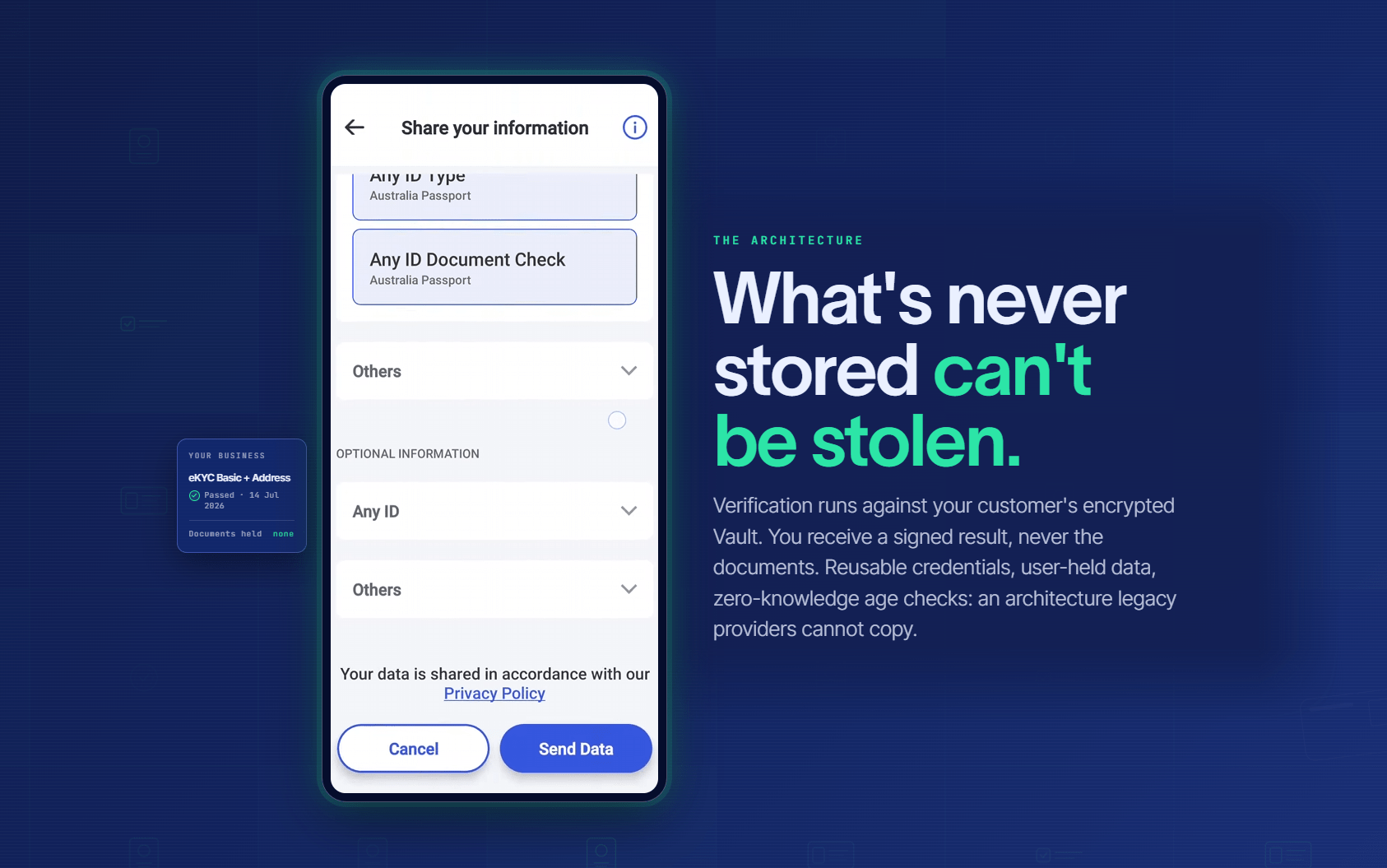
That changes what a breach can even do to you. There is no honeypot to steal, because the documents were never on your servers and no vendor is sitting on a copy either. It also compounds in your favour: a customer verified with one Link business can share that same credential with the next one, with consent and no repeat check.
What is actually on the new page.
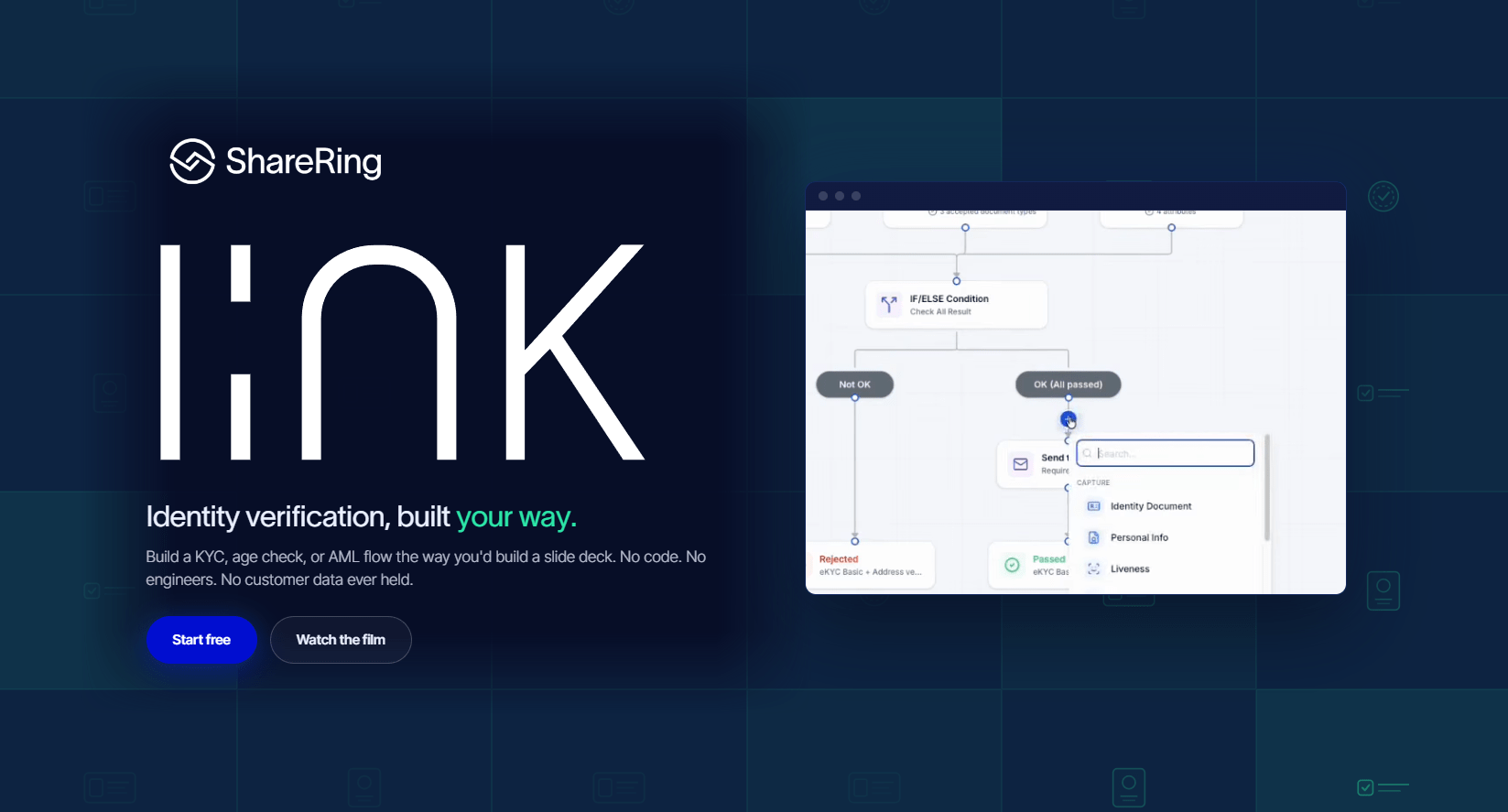
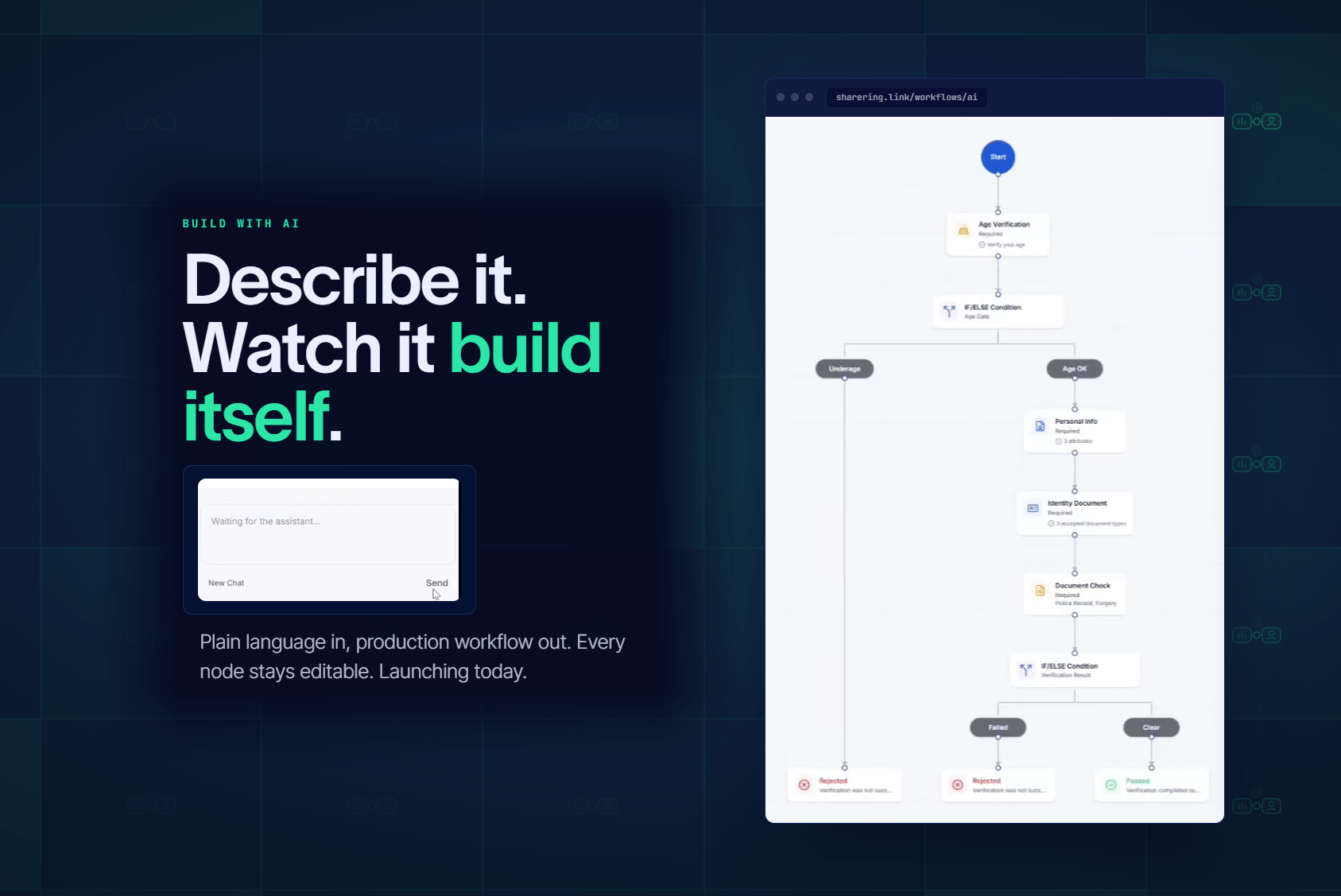
The AI builder is the part people react to. Describe the check in plain language, the way you would explain it to a colleague, and the workflow drafts itself node by node with every node still editable. Underneath that sit ready-made templates for age verification, eKYC Basic, eKYC plus age verification, and exchange-grade eKYC.
Pricing is published in full rather than hidden behind a form, at US$0.65 for an age check and US$0.85 for a one-document identity verification, with a complete run covering two documents, age, proof of address and watchlist screening landing at US$2.60.
The trial is 14 days with 10 verifications included, and the sandbox is free.
There is also a film, under two minutes, recorded in the product rather than in a design tool.
No-code identity verification is not a downgrade.
The suspicion is fair, so here is the answer. This is the same engine running underneath Prompt Pass at Thailand Post, which we wrote about in 144 Years of Delivering Paper, and the same engine behind the UK work we covered in What Is DIATF and Why Does It Matter for Your Business. The infrastructure is certified against ISO/IEC 27001:2022, ShareRing is an AUSTRAC reporting entity, and the architecture is aligned to GDPR, CCPA and the Australian Privacy Principles.No-code identity verification is not a smaller tier of the product. It is the same verification engine with the integration work already done, which is why the sandbox and the enterprise deployment run the same checks against the same rails.
FAQ
What is ShareRing Link?A no-code identity verification platform. Compliance and operations teams build KYC, age and AML workflows in a browser, share one verification link with customers, and receive signed webhook results. No engineering required to launch.
Do I need a developer?
No. The visual builder and the templates are designed for non-technical teams. Developers can extend it through the @sharering/link2 SDK, OAuth 2.0 and scoped API keys when you want deeper integration, but nothing about going live depends on them.
What does the free trial include?
14 days and 10 verifications, plus a free sandbox for building and testing before you go live. Billing afterwards is pay as you go, with no subscription, no minimums and no lock-in.
Where does customer data actually go?
Into the customer’s own encrypted Vault on their device. Your business receives only the attributes your workflow asked for, delivered by signed webhook with HMAC-SHA256 verification. ShareRing holds no central store of customer identity documents.
Does this satisfy AUSTRAC Tranche 2 obligations?
ShareRing Link handles the customer due diligence and record-keeping layer, with workflows shaped around AUSTRAC requirements. Your AML/CTF program, risk assessment and reporting obligations still sit with your business. Our Tranche 2 compliance guide covers the full picture.
Can I move across from another provider?
Yes, and most teams recreate their existing flows in an afternoon. Because results arrive as signed webhooks, switching usually means pointing your backend at a new endpoint.
Where ShareRing sits in this.
We have been building privacy KYC since our 2018 whitepaper set out the encrypted Vault and the self-sovereign identity model. Everything since has been the same idea at larger scale, across the three fronts we described in Three Fronts, One Quarter.
ShareRing Link is that model packaged as no-code identity verification, so a compliance officer can deploy it without a project plan, and the new page is the first time we have shown it properly.
Go and build one.
Regulators are not moving their deadlines because your integration is sitting in a queue, and your customers are not getting more relaxed about emailing photos of their licence. The gap between knowing what you need to check and actually checking it is the thing we set out to close, and we are closing it now.
By Rohan Le Page, Founder and Co-CEO of ShareRing
#ShareRingLink #PrivacyKYC #NoCode #IdentityVerification #Tranche2 #Private #Secure #Verified