
This is what successful partnerships look like.
On 3 August 2026, Thailand Post turned 144 and announced that Prompt Pass, the first digital document wallet in Thailand built on verifiable credentials, will be available to the public on 14 August.
A postal service spends its life guaranteeing that a document reaches the right person, unopened, with proof it was sent. Prompt Pass is that same guarantee, moved into the digital layer.
The announcement came at Thailand Post’s 144th anniversary press conference, alongside a new corporate strategy called RelationSHIFT, which shifts the organisation from volume-based growth to value-based growth. On stage the digital push carried its own banner, The Next Growth Engine, unleashing new momentum towards the future of Thailand Post. Underneath RelationSHIFT sits a framework called POSTsible Next and, for 2026 to 2027, three delivery pathways. The third one is the one that matters here: National Trust-Based Social Infrastructure.
Prompt Pass is a joint effort delivered by TKC, Transformational and ShareRing, in alignment with national policy set by the Ministry of Digital Economy and Society, and with standards and framework set by ETDA, the Electronic Transactions Development Agency. Thailand Post is the operator and the announcing party. ShareRing built the verifiable credential layer underneath it.
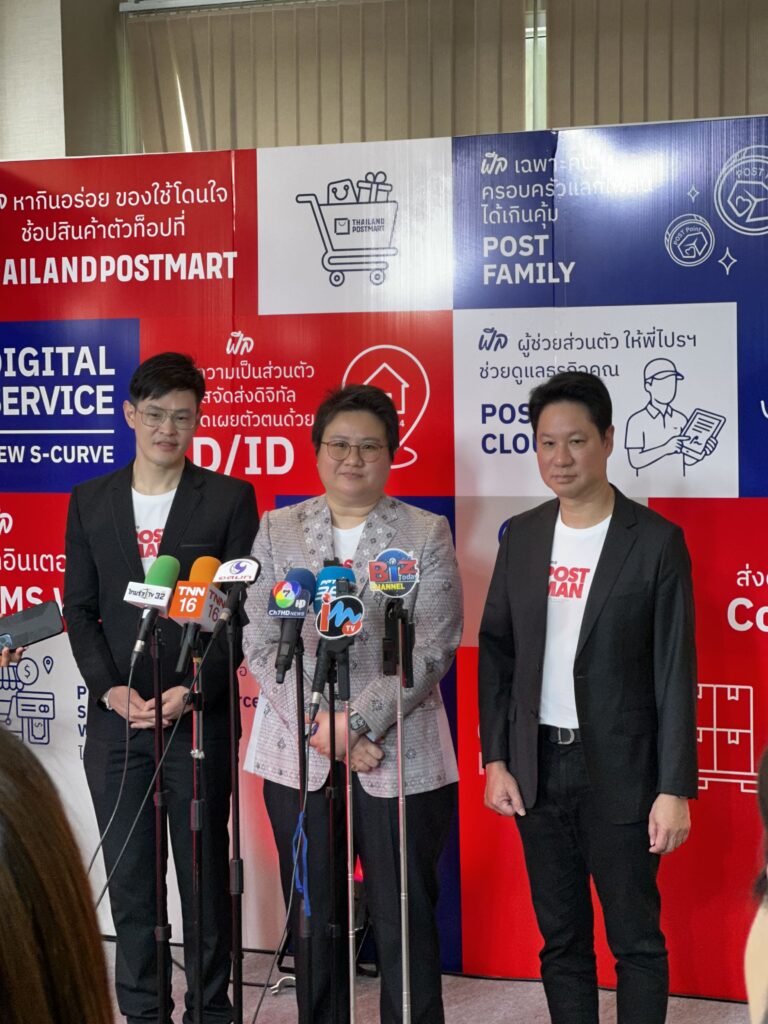
In the press
The 3 August announcement: Bangkok Post and FM91 Bangkok. The June pilot: BizTalk News, TechMoveOn and MGR Online.
These and the rest of the Thai coverage are in the ShareRing newsroom.
The public record, 3 August 2026
144 years of Thailand Post, marked with a new corporate strategy called RelationSHIFT.
14 August 2026, the date Thailand Post announced Prompt Pass will be available.
50,000+ service points nationwide, the network the Ministry of Digital Economy and Society cited when describing Thailand Post as part of Digital Public Infrastructure.
22,172.57 million baht total revenue in FY2025, with 11,368.25 million baht in the first half of 2026.
700+ students in the June 2026 digital transcript pilot with SBAC.
What the public record shows about Prompt Pass.
In June 2026 Prompt Pass ran a digital transcript pilot in the education sector with SBAC, and Thai technology and business media covered it at the time, including BizTalk News and TechMoveOn. We wrote about it at the time in Thailand Post Just Launched Verifiable Credentials.
That pilot put more than 700 students through a real career day. They requested their transcripts in the wallet, and employers received documents they could verify on the spot, with no phone call to the registrar and no waiting on a paper copy that may or may not have been genuine. It was a single campus and a single document type, and it was deliberately small, because the point of a pilot is to find out what breaks before a country is relying on it.
What happens on 14 August is the step up from that. The anniversary announcement, reported by FM91 Bangkok and in the Bangkok Post (paywalled), put the strategic frame around it. The Bangkok Post described Thailand Post as repositioning itself into a lifestyle logistics brand connecting people, businesses, communities and government services across its nationwide network. Deputy Minister of Digital Economy and Society Ms Boontida Somchai described Thailand Post as a key part of Digital Public Infrastructure on the back of a network of more than 50,000 service points, in service of what she called a country of opportunity, where every citizen can reach services, knowledge, markets and economic opportunity on equal terms.
The roadmap runs past education, toward verifying online senders and sellers, so a customer buying from a merchant they have never heard of can establish the provenance of who they are dealing with before any money moves.
Verification has always been the slow part.
Every document scam exploits the same gap, between a document that looks legitimate and one that has been checked.
A forged transcript works because verifying a real one is painful enough that people skip it. A fraudulent seller works because there is no cheap way to establish who is behind the account. The forgery is rarely clever. Checking is just expensive enough that people skip it, and that has protected fraud for decades.
The instinctive fix is to demand more documents, more copies, more uploads, which is exactly the wrong direction. It hands more sensitive data to more organisations, each of which becomes another breach waiting to happen, and it still does not answer the original question of whether the document is real.
This is what privacy KYC fixes.
A verifiable credential is a document you hold, that anyone can check, that nobody can forge.
The issuing organisation signs it once, you keep it, and you decide who sees it. The organisation checking it does not phone the issuer, does not store a photocopy of your passport on a server it will eventually lose, and does not build a database that becomes a target. It checks the cryptography and gets a yes or a no.
That is privacy KYC technology, and it is what ShareRing has been building since our 2018 whitepaper set out the encrypted vault and self-sovereign identity model. Prompt Pass is the largest deployment of it we have ever been part of. The same argument, applied to a country rather than a company, is one we made in Why a Country Needs a Private Digital Postbox.
Trust is the asset a postal service already owns.
Plenty of organisations can build a wallet. Very few can hand one to a country.
More than 50,000 service points reach people that digital-only services never will, in places where an app-first assumption breaks down. Someone who cannot complete a digital onboarding can walk into a branch, be verified in person by an institution their family has trusted for generations, and walk out holding the same credential as anyone else. That is what National Trust-Based Social Infrastructure looks like on the ground.

It also explains why the ETDA alignment matters. Prompt Pass was never built as a private silo, it was built to plug into a national framework with interoperability and standards set by the people whose job it is to set them. Thailand has been ahead of most of the world here for a while, which we covered in Thailand’s Digital ID Framework Is Already in Phase 2, and our route in was through TKC, our Thailand infrastructure anchor.
Frequently asked questions.
What is Prompt Pass?
Prompt Pass is Thailand Post’s digital document wallet, and the first in Thailand built on verifiable credentials. It holds documents issued to you by the organisations with the authority to issue them, and lets you share them in a form anyone can verify.
When is it available?
Thailand Post announced at its 144th anniversary press conference on 3 August 2026 that Prompt Pass will be available on 14 August 2026.
Who built it?
It is a joint effort delivered by TKC, Transformational and ShareRing, in alignment with Ministry of Digital Economy and Society policy and to ETDA standards. Thailand Post operates it.
What has it done so far?
A digital transcript pilot with SBAC in June 2026, covering more than 700 students at a single campus. Students requested transcripts in the wallet and employers verified them on the spot.
How does a verifiable credential stop forgery?
The credential carries a cryptographic signature from the issuer. Altering a single character breaks the signature, so a forgery fails the check immediately rather than passing a visual inspection.
Does the verifier end up holding my data?
No. That is the point of privacy KYC. The verifier confirms the credential is valid and issued to you, without needing to keep a copy of the underlying document. You can read more about our approach on the ShareRing platform.
Why Transformational.
We had the technology years ago. ShareRing has been building verifiable credential infrastructure since 2018. What we did not have was a way into Thailand.
Transformational did.
Bi Ariya and his team spent months working across a state enterprise, a ministry, a regulator and a listed systems integrator, in Thai, to Thai institutional norms. Government programmes do not move because someone has good software. They move because someone credible has spent years earning the right to be in the room, and keeps turning up when the answer is still no.
That is why we did not approach Thailand as a sales territory. In January we took a stake in Transformational and wrote about why in Connecting a Nation. We wrote then that you win national infrastructure through partnerships, not products, and that a foreign vendor flying in with a wallet was never going to become part of a country’s digital public infrastructure. Seven months on, that has held up.
The split is simple. Transformational owns the relationships, the government process and the programme. TKC brings the delivery capability and the systems integration weight that a national rollout demands. ShareRing brings the privacy KYC and verifiable credential layer, built by our engineering team in Vietnam under Tim Bos. Thailand Post owns the product, the customers and the trust.
If you are a technology company trying to get into a market like Thailand, that is the answer. You do not get in. You partner with someone who is already in, you give them something worth having, and you accept that your name goes third in the list.
Thank you.
Every line of the technology behind Prompt Pass was built by our engineering team in Vietnam, led by Tim Bos. They wrote the credential layer, stood up the infrastructure and ran the SBAC pilot from Ho Chi Minh City. When a country announces something on its national broadcaster, the people who made it work are almost never in the room.
Bi Ariya and the Transformational team, Te, Kla, Tum, Pop and everyone alongside them, carried the rest.
This has been an enormous amount of work by a lot of people over a long time, and most of it was invisible. Moments like these define companies, and this one gets cherished in ShareRing’s history for a very long time. Thank you, all of you.

We are in Thailand building this right now.
Our team is in Bangkok, working alongside TKC and Transformational on the verifiable credential and digital document wallet infrastructure Thailand is rolling out. We are not commentating on national digital identity from the outside. We are shipping it, and on 14 August a country gets to use it.
Alison Le Page, our marketing lead, and I will both be in Bangkok on 14 August for the launch, alongside Thailand Post, TKC and Transformational. If you are there, come and find us.
If your country or your organisation is heading toward the same problem, reach out to me directly. It costs far less to build the trust layer properly the first time than to unpick a decade of stored document copies later.
By Rohan Le Page, Founder and Co-CEO of ShareRing
#PrivacyKYC #DigitalIdentity #PromptPass #ThailandPost #VerifiableCredentials #ReusableKYC #Private #Secure #Verified