
By Rohan Le Page, Founder and Co-CEO of ShareRing
Most companies our size spend everything they have trying to buy users. On Saturday in Bangkok I watched Thailand Post commit to doing it for us.
The occasion was the launch of the 35th J-MAT Award, the biggest and longest-running marketing plan competition in the country, run by the Junior Marketing Association of Thailand. Thailand Post put Prompt Post up as this year’s brief, opened its own platform numbers to a room full of university students, and set them one challenge: work out how to get Thailand to adopt the digital document wallet.
Prompt Pass is that wallet, and it runs on ShareRing’s technology.

So here is the announcement. A government enterprise that has been delivering across Thailand since 1883, with a brand Thais have trusted for generations, has taken a product built on our infrastructure and started spending its own marketing budget to sell it. The 50,000 service points in its nationwide network are the storefronts.
We are not the ones acquiring these users. Thailand Post is.
What was actually announced
Two people presented. Dr Phurith Mitrsomwang, Director of the PostNext division at Thailand Post, took the product. Ariya Banomyong, CEO of Transformational and advisor to Thailand Post, took the market challenge.
Ariya’s two jobs are the reason any of this works. He advises Thailand Post on its digital strategy, and he runs the company delivering Prompt Pass alongside TKC and us, which means the person shaping what a government enterprise wants is the same person accountable for building it. Partnerships between technology companies and national institutions usually break somewhere in the gap between those two jobs, and there is no gap here.

Then they did the thing almost nobody does at an event like this, which is open the books.
The platform carries 94,074 registered users and around 100,000 active. Of those, 52,111 have completed identity verification and can receive documents today, which is fifty two thousand verified Thai citizens sitting on the platform before a single baht of marketing has been spent against it.
Then the money. The teams plan against 5 million baht for the first twelve months and 5 million a year for the three years after that, with every activity in the plan required to justify its return. Twenty million baht, aimed squarely at driving adoption of the platform our wallet sits inside.
The pricing is already set and running. A digital transcript costs 100 baht for the person requesting it, an electronic signature is 18 baht per transaction, and a legally effective timestamp is 6 baht.

Why this beats the press conference
We have had good days in Thailand this year. The digital transcript pilot with SBAC in June. The 3 August press conference, where Thailand Post marked its move into a 144th year of operation and named Prompt Pass as part of its growth strategy with the Deputy Minister of the Ministry of Digital Economy and Society standing on the same stage.
Those were announcements. This is a budget.
An announcement tells you a partner believes in you, and a budget tells you a partner has decided to sell what you built at scale, using their brand and their money to do it. Twenty million baht and a national competition is a go-to-market plan with a number attached to it.
They are also running it through their distribution rather than ours. Post offices across the country, postal workers in every district, LINE and Facebook and TikTok and X accounts with national reach, and the channels of every partner organisation connected to the platform. Reach on that scale is exactly why you partner with a government enterprise.
The brief the students were handed
This was not a request for advertising ideas. The teams walked away with a working brief that would not look out of place inside a well-run startup, and the shape of the ask tells you how seriously Thailand Post is taking this.
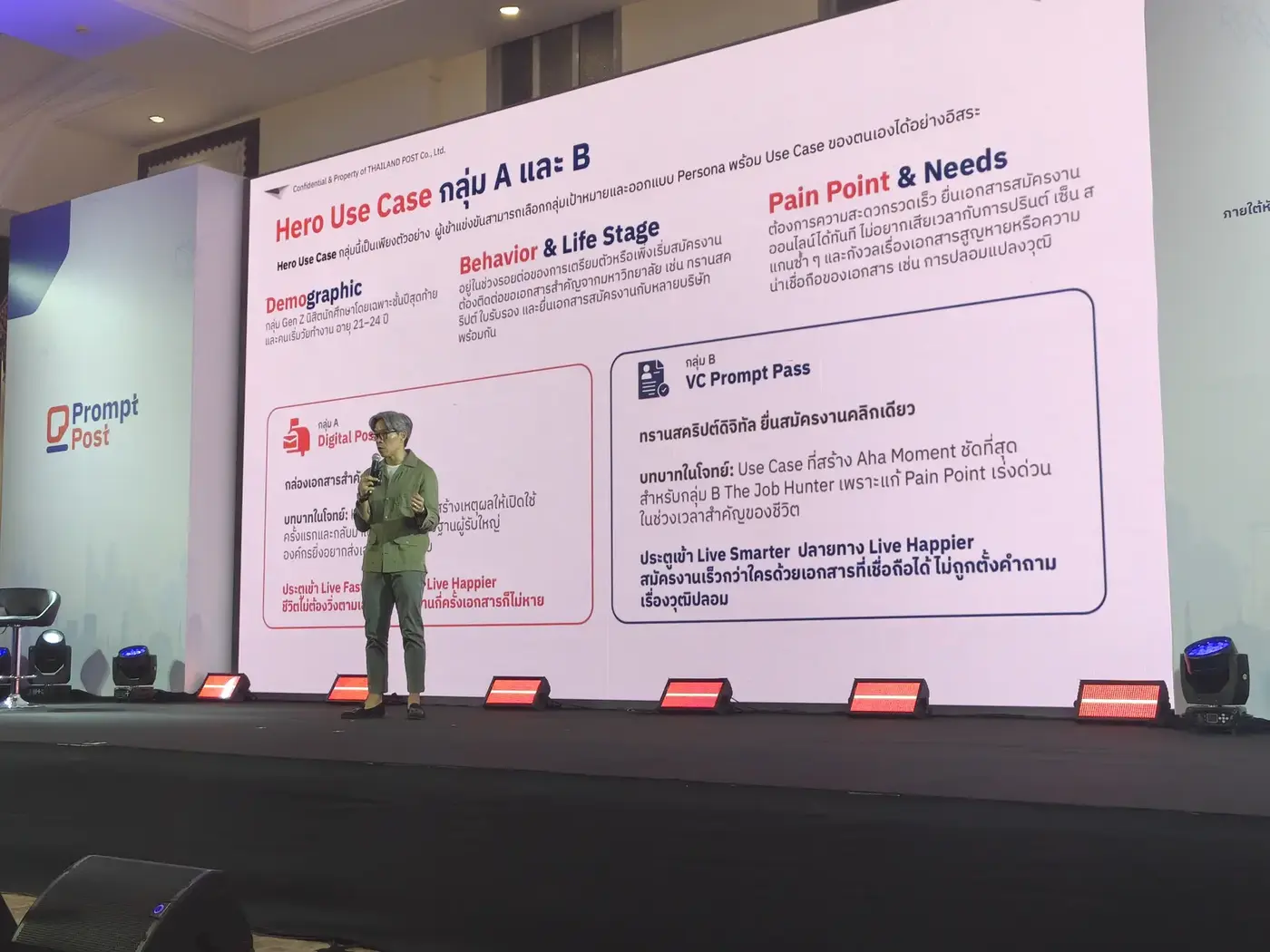
Each team must choose a single hero use case and a single audience, then build the entire plan around that one wedge. The deck is blunt about why. The losing move is to advertise all eight services at once, explain what the app can do instead of solving one person’s problem, and buy broad awareness that gives nobody a reason to download today.
The plan runs in three phases across twelve months. Build awareness and pre-register a base of recipients before their first document ever arrives, then drive activation until each new user reaches their first real action, then hold retention and expand into the rest of the platform. Every activity has to justify its return on marketing investment, competing on price alone is against the rules, and overstating what the product can do is grounds for disqualification. A proposed feature has to be labelled a proposal.
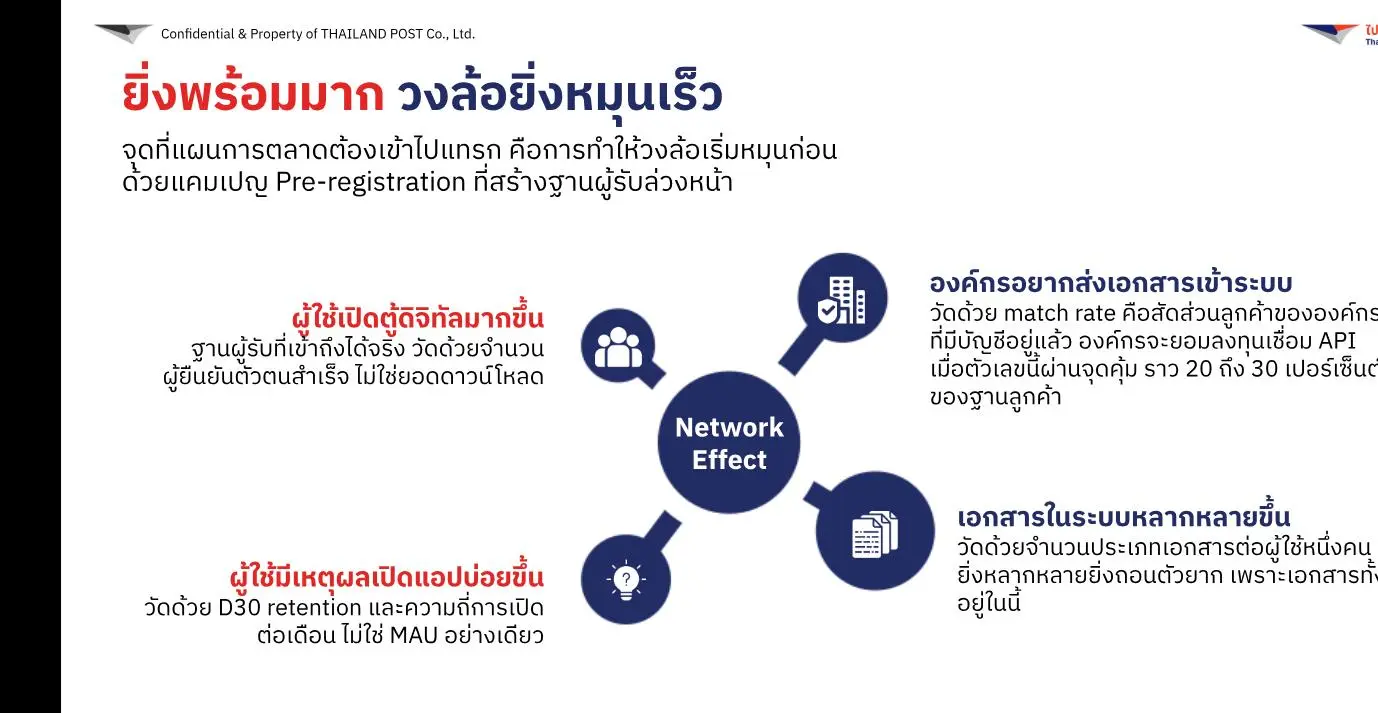
Buried in the middle of the brief is the hardest problem in the whole platform, and Thailand Post names it rather than hiding it. They call it the passive trigger. A document wallet is an app people open when something arrives, which means nobody discovers it before then, and the platform cannot grow on product experience alone. If no documents arrive, nobody has a reason to sign up, and until enough people sign up, no organisation wants to connect and start issuing. The brief asks the students to crack that loop, and points at pre-registration, signing people up before the first document ever lands, as one way in.
One more number in the brief deserves attention. Thailand Post’s own analysis says an organisation will invest in connecting to the platform once roughly 20 to 30 percent of its customers already hold verified accounts. The whole campaign is aimed at crossing that threshold, because on the far side of it the issuers start arriving on their own.
The four people in the deck
The brief sketches four Thais the teams can build for, and they are worth meeting, because every one of them is somebody our industry has been promising to help for a decade.
The first is a fresh graduate, twenty two to twenty seven, who moves house about once a year and whose mail does not keep up. The bank letter and the government notice chase an old address until a deadline quietly passes, and there is no fixed place where the paper that matters actually lives. For them the pitch is a digital address that never changes, no matter how many times they move.
The second is the job hunter, anywhere from twenty two to thirty five, applying to several companies at once and needing certified documents for all of them. They wait days for a transcript, pay for the privilege, and then watch HR phone the university anyway. They are the reason the transcript is the hero use case.
The third runs their own show, a freelancer or a small business owner who closes deals on contracts and lives inside a print, sign, scan and send loop that eats three to seven days per document, on paper that cannot even prove when it was signed. An electronic signature with a legally effective timestamp closes the same deal in a day.
The fourth is a working parent between thirty and fifty who manages every bill in the household, each one arriving through a different channel, paid in a different app, with receipts that never quite survive until tax time. For them the wallet is one place where the bills arrive, get paid and stay filed.
The teams pick one and go deep, which is the correct discipline. It is also a map of where Prompt Pass goes after transcripts, because each of those four people is a use case the platform has already built for.
Prompt Pass, and our part in it
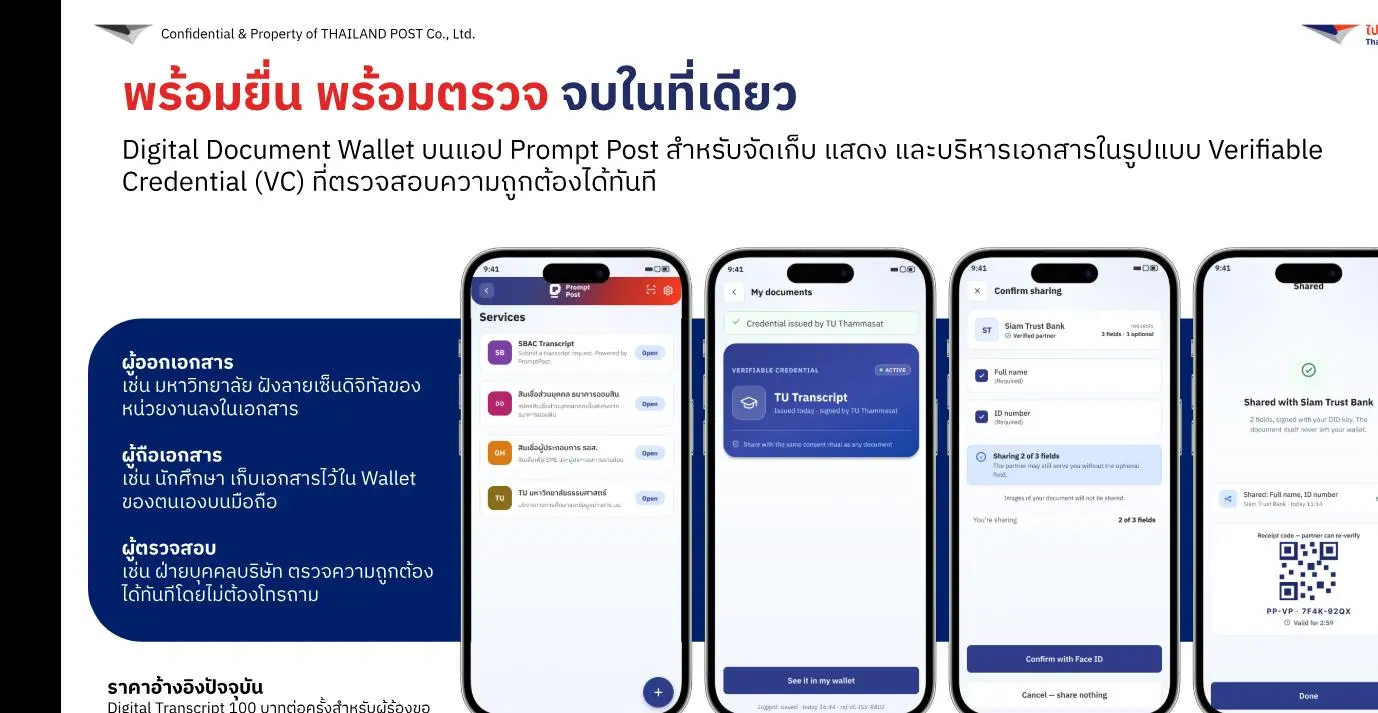
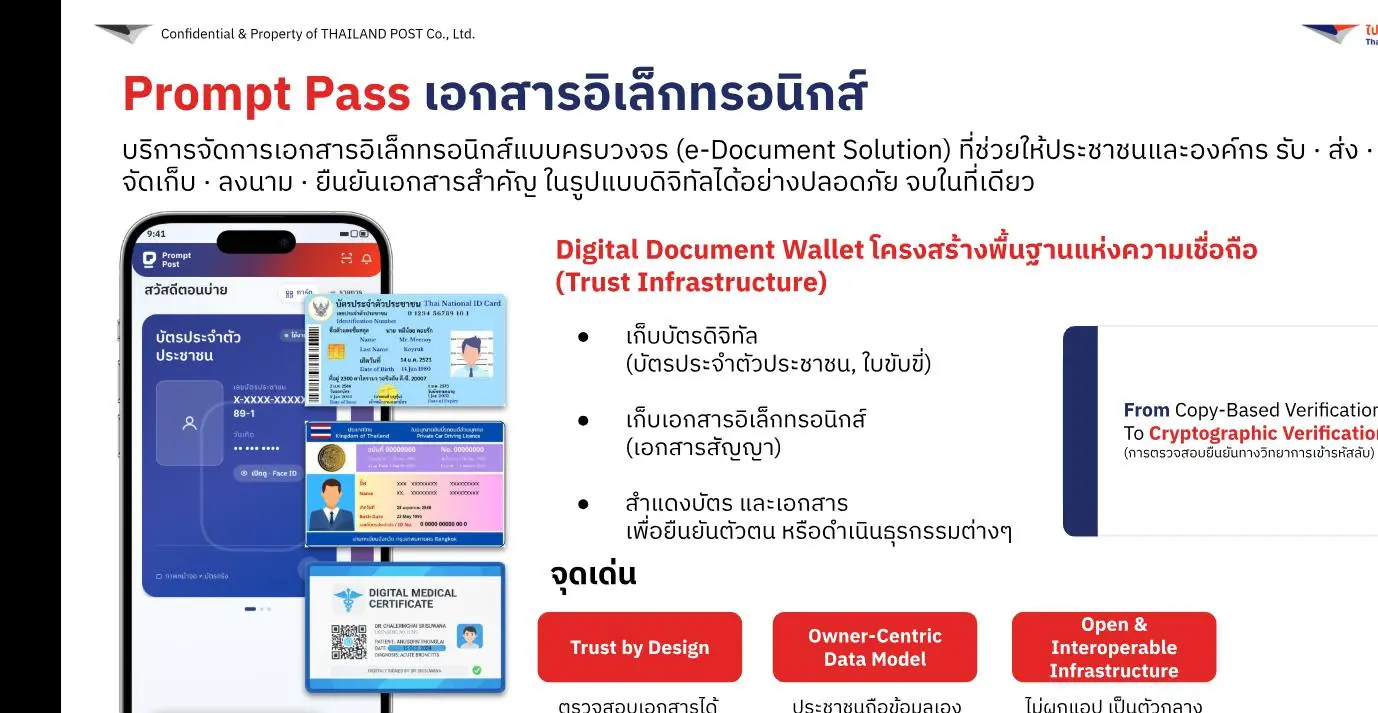
Prompt Pass is the verifiable credential digital document wallet inside Thailand Post’s Prompt Post platform. It is delivered as a joint effort by TKC, Transformational, and ShareRing, in alignment with national policy set by the Ministry of Digital Economy and Society, and with standards and framework set by the Electronic Transactions Development Agency.
The split between us is clean. Transformational is the delivery partner on the ground in Bangkok, led by Ariya. TKC brings the systems integration. We bring the wallet and the credential infrastructure underneath it. Thailand Post owns the customer, the brand, the national network and now the go-to-market.
Identity verification runs through ThaID, Thailand’s national digital identity from the Department of Provincial Administration.
Underneath all of it sits the same mechanic we have been building for years, and it comes down to three parties.
The issuer. A university, a government agency, a bank. It embeds its own digital signature into the document at the moment it creates it.
The holder. The citizen. The document sits in their wallet, on their phone, under their control, rather than on the issuer’s server or in a central government store.
The verifier. An employer, a landlord, a border desk. They check the signature themselves and have an answer in seconds.
Thailand Post’s own deck puts the shift better than I have managed in years of trying: from copy-based verification to cryptographic verification.
The proof point is a transcript
The first use case going to market is a digital transcript, which is the right call, because the pain is sharp and it lands at a point in someone’s life when they are paying close attention.
A graduate applying for jobs needs their transcript. Today they pay a fee, wait days for it, send a PDF across, and the employer still picks up the phone to ask the university whether the thing is real. The document arrives and the problem it was meant to solve is still sitting there untouched.
On Prompt Pass that same transcript costs 100 baht, a little over four Australian dollars, and the employer verifies it themselves in seconds. Nobody phones anyone.
This is a verifiable credential doing an ordinary job for an ordinary person at a price nobody thinks twice about, and once it works for a transcript the same mechanic carries a tenancy agreement, a professional licence, an insurance policy or a proof of entitlement.
The number that matters
Thailand Post put its own acquisition funnel on the screen. Twelve thousand people download the app in a typical month. Around 10,800 of them stay guests at first, about 6,000 go on to register, around 4,200 complete identity verification through ThaID, and 2,940 reach a first real action, opening a document, paying a bill, tracking a parcel, the moment the deck calls seeing the value. From twelve thousand down to under three thousand, and the single biggest leak sits between guest and member, where 4,800 people, 44 percent of everyone who downloaded that month, walk away rather than register.
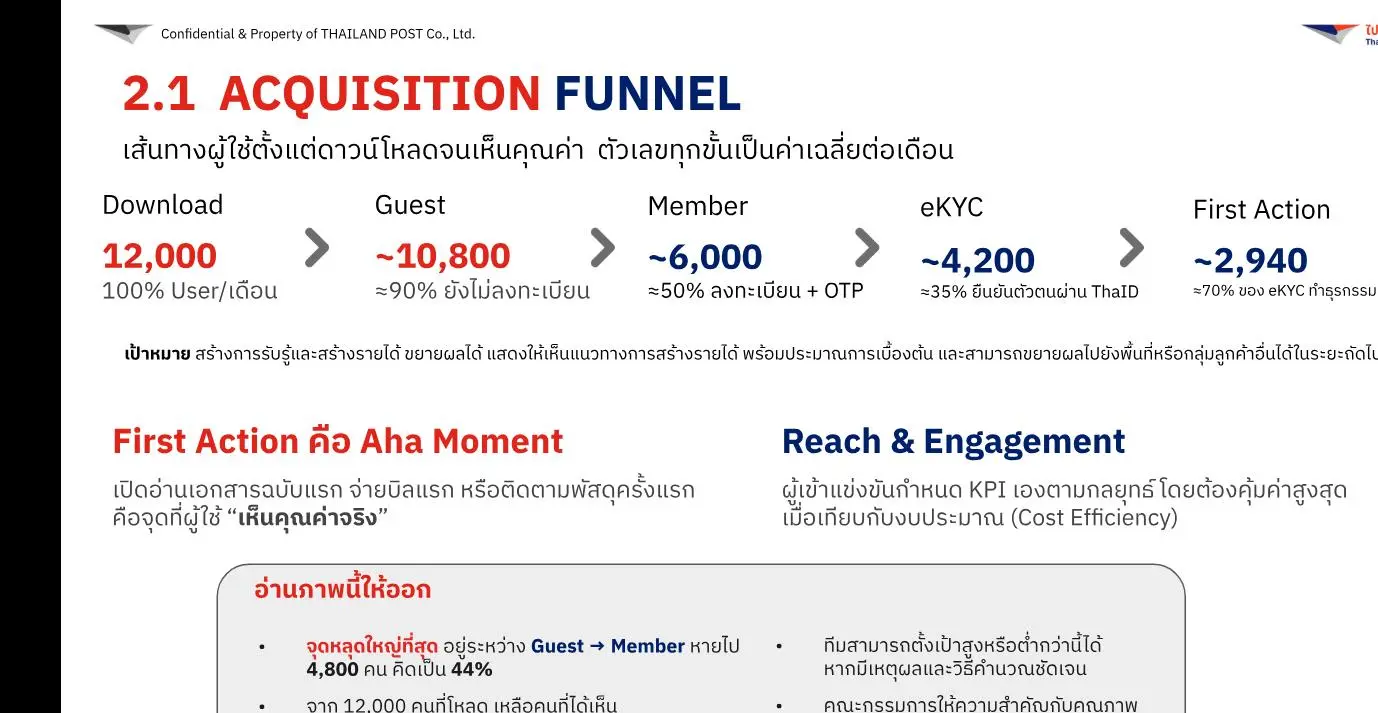
The leak is the same one every digital identity project on earth is carrying, ours included. The cryptography works, the wallet works, and adoption dies at a registration form. Thailand Post’s curve looks like everyone else’s. The difference is that theirs is now on the table with a budget and a room full of marketing students attached to it, and problems get solved where the money is.
The friction is identity verification itself. Verifying on Prompt Post requires ThaID first, which means two apps and several steps at exactly the moment a new user has the least patience and the least reason to push through. The deck lists it as the first consumer barrier in its own words: people find the process complicated and do not understand why it takes so many steps. Fixing that one moment is worth more than any feature either of us could ship, and it sets up the one advantage no competitor can copy.
The network under the wallet
The asset Thailand Post brings took 143 years to build.
If a recipient does not open a document within a set window, the system prints it and posts it as physical mail automatically, through the same network that has been delivering across Thailand since 1883. Digital is the default and paper is the fallback, so a document always arrives whether the recipient is digital or not.
A few European postal services run hybrid delivery of this kind, and every one of them is moving plain letters. What none of them has done is put a verifiable credential wallet on top of it, so that the documents moving through the system are not just delivered but cryptographically verifiable by whoever receives them. Meanwhile the postal operators that went digital without leaning on their physical network have been shutting those services down, Canada Post’s epost in 2022 and Australia Post’s Digital iD this year among them. The digital-only path has been tried by posts around the world, and it keeps dying.
Thailand Post is doing something different. It is fusing the wallet with the network, so that the same infrastructure that guarantees a document arrives also guarantees it can be trusted, and post offices and postal workers across the country become identity verification points for the platform. The funnel above shows registration is precisely where the platform loses the most people, and Thailand Post is the only player in the market holding a physical answer to it.
Nobody else has put those two things together, which is the moat.

We have spent years building this infrastructure and arguing that it was the right architecture for document trust. On Saturday I sat in a room where a national institution explained it in Thai, to its own market, with its own money behind it, and did not need us there to translate.
That is what taking a product to market looks like.