
Every other AI you use today is building a profile on you. What you ask is recorded. What you say is uploaded. What you search becomes training data. The model is centralised, the data is centralised, and the control is theirs.
Today that deal dies. The waitlist is open for Digital Me, the world’s only private AI assistant. Your AI runs on a private server that is yours alone. Your credentials stay in a Vault on your phone. Everything works.
This is the biggest thing we have ever built. We have all learned to live around the old trade: keep the real questions to yourself, paste in half the context, treat the most capable tool of your lifetime like a stranger on a train. Eight years of ShareRing infrastructure went into ending that. Today you get to see it, and if you join the waitlist, you get to test it.
Digital Me at a glance
The world’s only private agentic AI assistant. Every user gets their own private AI server, an isolated personal stack provisioned automatically from your decentralised identity the first time you open the app. Credentials stay in an encrypted Vault on your device, behind your fingerprint or face, and leave only field by field with your consent. 13 skills at launch, all real and executable: flights, hotels and restaurants booked and paid inside one conversation. Replies begin in under two seconds. Every action needs your explicit slide to authorise. Built on ShareRing’s self-sovereign identity infrastructure, in production since 2018. The waitlist is open at sharering.network/digital-me, and waitlist members will get the chance to test the MVP. Full architecture in the Digital Me Technical Whitepaper.
The world’s only private AI assistant, and why that matters
Ask yourself one question about the AI you use now: whose is it, really? You type your life into it, and someone else’s server remembers. Your questions become logs, your documents become context windows on machines you will never see, your habits become someone else’s asset. The industry has spent three years telling you that is the price of capability.
We are calling that what it is: a design failure, not a law of nature. Digital Me gives every user their own private AI server, an isolated personal stack that is yours alone, provisioned automatically from your decentralised identity on first launch. Your history and your memory are physically separated from every other user’s, never pooled, never mined. There is no shared prompt log, no training corpus built from your private life. When you ask a question, your own private stack answers it, and your credentials stay in the Vault on your phone until you release them, field by field, with explicit consent. Ask the kind of questions you would not type into anyone else’s AI. That is the whole point. We wrote about where this was heading in Digital Me: the identity-anchored evolution of sovereign AI. Five months later it is real, on a phone, taking bookings.
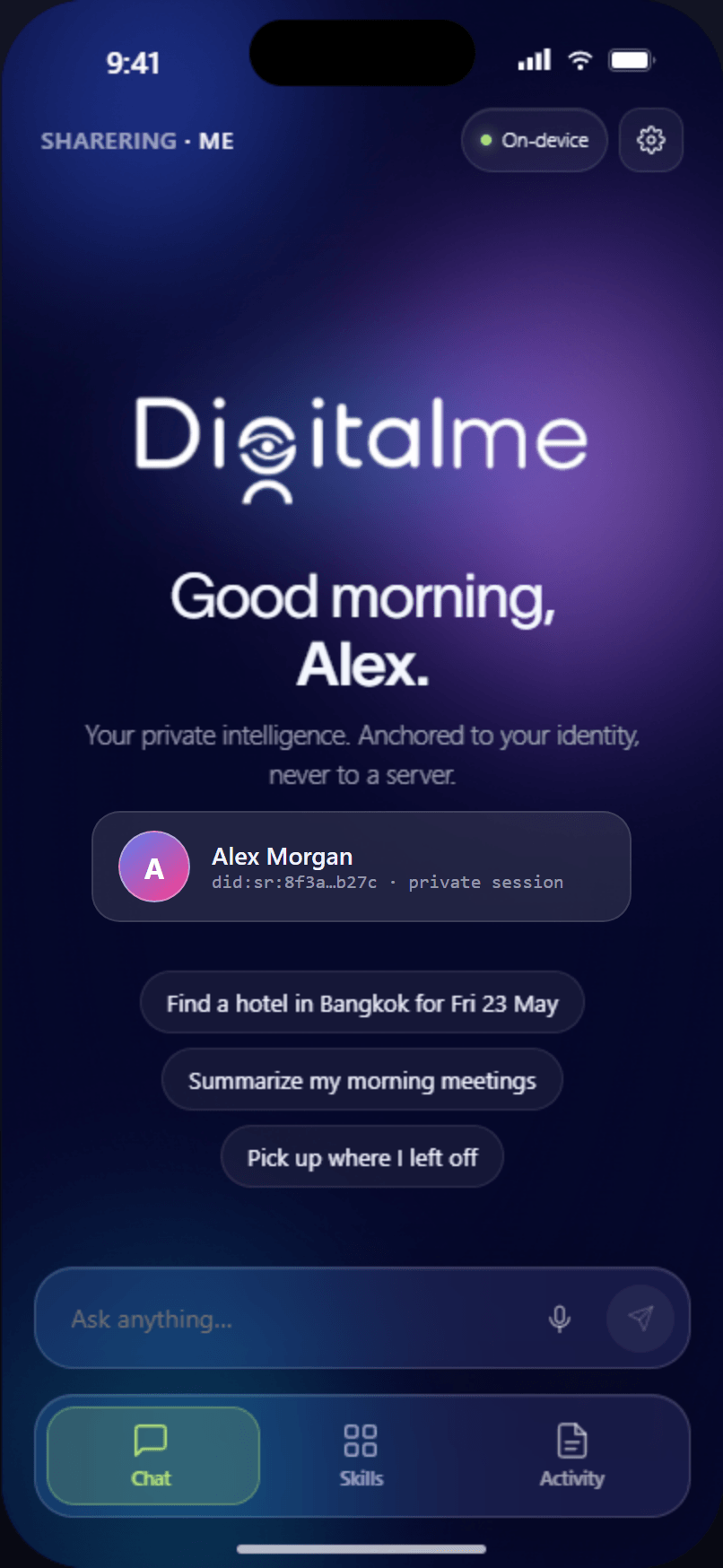
Meet it. Speak to it. It answers like a person.
You do not register an account. You meet your Digital Me. A face. A name. A voice that is yours, not theirs. That first meeting is the first moment of trust, and we designed it that way on purpose.
Then talk to it. Tap the mic once and speak. It listens, answers aloud in a voice that sounds human rather than robotic, and hands the turn back to you. No keyboard, no screen reader monotone. Plan a trip while you cook. Reorganise your week while you drive. Replies begin in under two seconds, streaming onto the screen as they are written, and live search results arrive as they are found. It feels less like using an app and more like having someone excellent on your side.
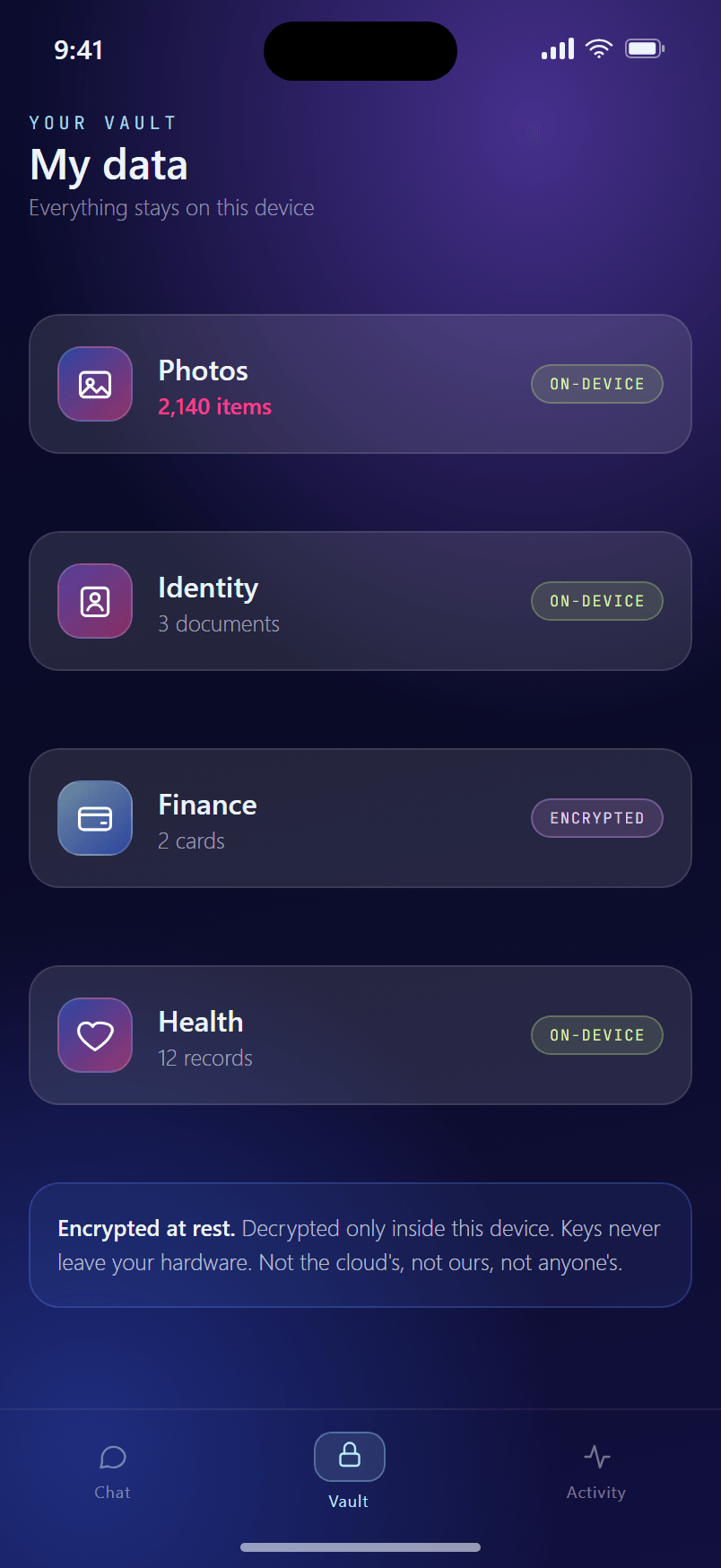
The Vault: your life, sealed on your phone
Underneath it all sits the Vault. Photos, messages, calendar, finance, identity, biometrics. Encrypted at rest, decrypted only inside your device, and the app itself will not even open a connection until your fingerprint or your face says so. Yours alone, not the cloud’s, not ours, not anyone’s.
We built our name on privacy KYC technology, proving who you are without handing over who you are. The Vault carries that principle into everything Digital Me touches. Need to prove you are over 18? Your Digital Me answers yes or no without ever revealing your date of birth, the same selective disclosure we described in Seven things that make self-sovereign identity different. Designed so that even someone holding your unlocked phone cannot reach your assistant, your history or your credentials.
13 skills at launch. Every one of them real.
Everything your Digital Me can do lives in the Marketplace. It launches with 13 skills, and every one of them executes for real on your own gateway: flights searched and booked with payment in the chat, hotels booked and compared, holiday stays, restaurant discovery with real table reservations, live flight status and an airport concierge, directions on live maps, weather, live web search, currency conversion at real exchange rates, your Thai arrival card prepared in seconds from your Vault, age verification that proves 18 plus without revealing your date of birth, and email sent from your own mailbox. Install one with a tap and it works that second, no restart, no app update. Toggle one off and it is gone, not lurking: an uninstalled skill is blocked at execution on your own gateway. Third-party skill publishing comes shortly after launch.
Two things make this Marketplace different from every app store you have used. First, radical disclosure: every skill tells you exactly which Vault fields it can touch and which outside services it talks to, before you install it. Second, the replies are not walls of text. Skills answer with rich, interactive cards, 18 types of them: flight results you can compare, hotel cards you can book from, live maps you can navigate with, checkout and confirmation cards that read like receipts. The assistant stays lean, holding only the capabilities you actually want, and the Marketplace is how it grows with you instead of growing a dossier on you.
A day with your Digital Me
Here is what agentic actually means when it is yours. You say: find me a quiet hotel in Bangkok near the river, Friday to Sunday. It searches privately and streams back real options, ranked to the preferences it has learned from you, priced in your own currency. You pick one. It books it, and the flight, and a table for Saturday night, in the same conversation, with a secure checkout for each. Nothing is charged until you slide to authorise, and every price is shown in your money before you do.
Travel day. It is watching your flight’s live status, so you are not refreshing an airline app at the gate. Landing in Bangkok, it walks you through the airport like a concierge: transport, immigration tips, where to get a SIM, an interactive terminal map when you ask where the tax refund counter is. Your arrival card is prepared in seconds from your Vault identity, with your consent, before you reach the queue. Then you ask the question that shows the whole difference: how do I get to my hotel? It already knows which hotel. It booked it. It routes you there on a live map without asking a single clarifying question. That moment, when your assistant connects the dots because it actually knows your life, is what every other AI has promised and none has delivered privately.
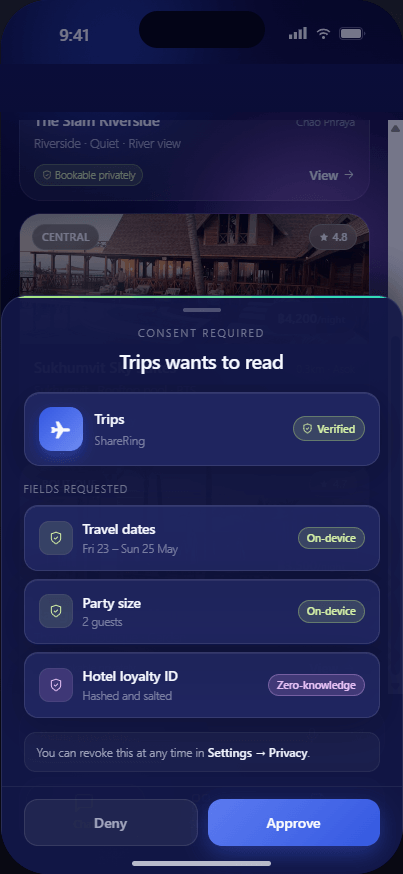
Every action asks first. Every action is on the record.
Autonomy without consent is not intelligence, it is a liability with a marketing budget. Digital Me does not have it. Every data share and every payment surfaces a consent sheet showing exactly which fields a merchant will receive, and nothing moves until you approve it with a deliberate slide. No accidental bookings, no silent data-mining, no hidden charges.
And it keeps receipts. Every booking, share and payment your assistant has ever made is written to your own activity ledger. Tap any entry for the detail, modify or cancel from right there, contact the merchant with one touch. A permanent, self-owned paper trail of everything done on your behalf. The anti-black-box.
It shows you everything it knows. And hands you the delete key.
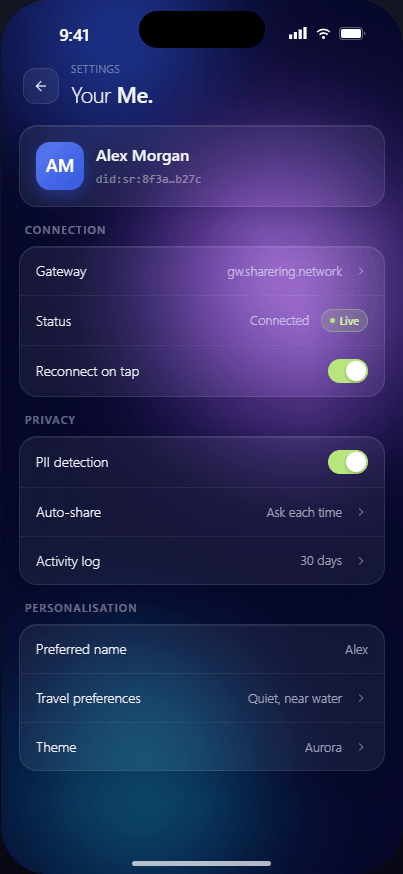
Most assistants forget you the moment the window closes. Yours remembers, on your terms. It learns your preferences, so flight results arrive ranked to your taste. It learns your facts, your people, your routines, and gets better at your tasks the more you use it. Your full conversation history lives with your assistant, not with your handset, so a lost phone or a reinstall costs you nothing: sign back in, resume any conversation you have ever had.
Then the part nobody else ships. Open Settings and there it is: everything your Digital Me knows about you, listed in plain language, editable and deletable one entry at a time. No other consumer assistant shows you its memory and hands you the delete key. Want to speed it up? Run the guided interview and teach it yourself, one question at a time, five minutes, resumable whenever. Your AI’s memory stops being something that happens to you and becomes something you direct.
Built on eight years of shipped infrastructure
Big claims need receipts, so here are ours. ShareRing has been building self-sovereign identity since 2018. The Vault and our SSI stack are live in production today, verifying real people for real businesses, as we covered in our 2026 strategic roadmap and in I hate digital ID, so we built the version that doesn’t suck. Digital Me is not a pivot and it is not a demo reel. It sits on top of infrastructure that has been doing this job for years. Not vapour.
The roadmap. No spin.
We want to be straight with you about where this is, because trust is the entire product. Phase one, the proof of concept, is live and working now. Phase two is the MVP, landing next, and waitlist members will get the chance to test it. Phase three is expansion through 2026: homomorphic encryption, full DAO governance, wider integration. Phase four is sustainability through 2027: ongoing research, partner expansion, new use cases.
Building private AI properly takes time and resources, and we will not pretend otherwise. Some of the hardest cryptography in the field sits between phase two and phase four. We would rather ship each phase solid than rush all four and break the one promise that matters. Watch the roadmap, hold us to it.
Frequently asked questions
What is Digital Me?
The world’s only private agentic AI assistant. Every user runs on their own private AI server, isolated and theirs alone. Your credentials stay in an encrypted Vault on your device behind your biometrics, and every action it takes requires your explicit consent.
How is it different from the AI assistants I already use?
They share servers and pool what they learn. Your Digital Me runs on a private server that is yours alone, remembers you there and nowhere else, shows you everything it knows, and completes real bookings and payments rather than suggesting links.
How do I join the waitlist?
Join on the Digital Me page, or scan the QR code there with the ShareRing app. It shares your name, email and ShareLedger address, and that is it.
What do waitlist members get?
A confirmation now, instructions soon, and the chance to test the MVP when it lands. You will be using Digital Me before the world does.
Is my data used to train the model?
No. Your Digital Me runs on your own private stack, physically separated from every other user’s. No shared prompt logs, no training corpus built from your life, and your credentials never leave your Vault without consent.
Where can I read the technical detail?
The Digital Me Technical Whitepaper covers the architecture, and the Briefing Overview is the short version. Both build on ShareRing Me and our identity infrastructure.
Whose AI is it, really?
Now, it’s yours. The waitlist is open at sharering.network/digital-me. Join on the page or scan the QR with the ShareRing app, read the whitepaper, and be first in line to meet your Digital Me. The profile-building era of AI had a good run. It ends here.
Join the waitlist to be the first to use the world’s only private agentic AI assistant.
 Scan with the ShareRing app. Share your name, email and ShareLedger address, that is it.
Join here, or scan the QR with the ShareRing app.
digitalme by ShareRing 2026
By Rohan Le Page, Founder and Co-CEO of ShareRing
#PrivacyKYC #DigitalIdentity #DigitalMe #PrivateAI #AgenticAI #SSI #Private #Secure #Verified