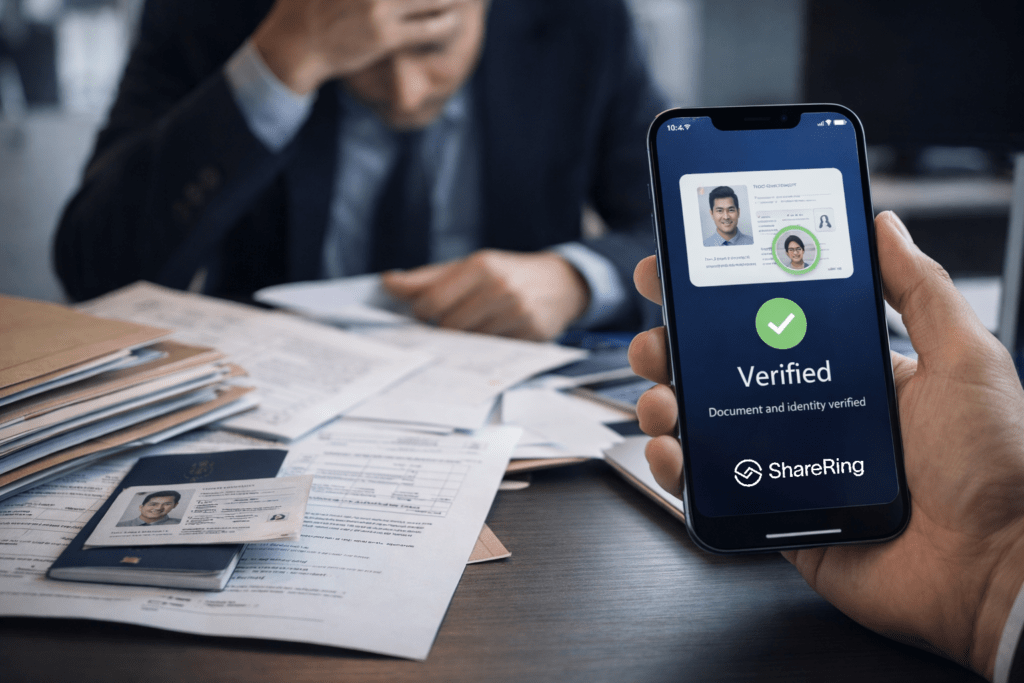
Self-sovereign identity (SSID) is not a marketing term. It is a specific technical and philosophical approach to how personal data is stored, controlled, and shared. Most identity verification companies do not use it. ShareRing does, and the differences are not subtle.
Here are seven things that set self-sovereign identity apart from the way most businesses handle customer data today.
1. The user holds the data, not the provider
In a traditional identity system, when you verify your identity with a business, that business (or their verification provider) stores your documents and data in a centralised database. You have no control over how long they keep it, who has access to it internally, or how well they protect it.
With SSID, verified credentials are encrypted and stored on the user’s own device, inside the ShareRing Me Vault. No centralised copy exists. The user decides what to share, with whom, and for how long. The provider never holds the raw data.
2. There is no honeypot to breach
Every major data breach in the identity space has targeted a centralised database. The logic is simple: if millions of identity records sit in one place, that place becomes an irresistible target.
SSID eliminates the target. Because each user’s data lives on their own device, there is no single repository for an attacker to compromise. A breach of ShareRing’s systems would not expose customer identity data, because ShareRing does not hold it. This is the architectural advantage that centralised providers fundamentally cannot replicate.
For businesses concerned about the reputational and financial consequences of a data breach (and with Australian penalties now reaching $50 million or more), this distinction matters enormously.
3. Verification is reusable
Traditional identity verification is a one-time event per business relationship. Every new provider you engage with runs the same checks from scratch, often using the same documents you have already verified elsewhere. It is slow, expensive, and creates yet another copy of your personal data in yet another database.
With SSID, verification is done once. The resulting credential lives in the user’s Vault and can be presented to any business that accepts it via ShareRing Link. A customer verified by their lawyer can present the same credential to their accountant without repeating the process. This saves time and money for everyone involved, and it reduces the number of places where personal data is stored.
4. Zero-knowledge proofs protect what you do not need to share
Here is a scenario most people have experienced: you need to prove you are over 18 to access a service. The business asks for your driver’s licence or passport. Now they have your full name, date of birth, address, licence number, and photo, all to answer a yes/no question.
SSID with zero-knowledge proof capability allows the user to prove a specific fact (such as “I am over 18”) without revealing any other information. The business gets the answer it needs. The user does not hand over their entire identity to get it.
ShareRing’s age verification capability uses this principle, and it was a core component of the Australian Age Assurance Trial.
5. The blockchain provides proof without exposure
When a credential is verified through ShareRing, a cryptographic hash is written to ShareLedger, ShareRing’s purpose-built blockchain. This hash serves as an immutable, timestamped record that the verification occurred and what the outcome was.
No personal information is stored on-chain. The blockchain is a proof layer, not a data store. It provides auditability (a business can confirm a verification happened) without creating another repository of personal data.
ShareLedger is an application-specific blockchain built for identity operations. Unlike general-purpose chains, this gives ShareRing predictable transaction costs and the ability to scale without being affected by network congestion. It also means ShareRing can evolve the chain’s capabilities specifically for identity use cases, without the constraints of a shared network.
6. Third parties can issue credentials without ShareRing in the middle
Most identity providers are the sole gatekeepers of the credentials they issue. If you want a verified credential from Provider A, you go through Provider A’s process, and the credential only works within Provider A’s ecosystem.
ShareRing’s architecture allows third parties to issue credentials directly into a user’s Vault without ShareRing mediating the transaction. A university could issue a degree credential. A government agency could issue a licence. A healthcare provider could issue a vaccination record. Each of these becomes part of the user’s unified identity, verifiable by any business through ShareRing Link.
This makes ShareRing not just a verification provider but an aggregator of trusted credentials from multiple sources.
7. The data standard is flexible, the security is not
ShareRing stores credentials according to the W3C Verifiable Credentials standard. But when a business needs data presented in a different format, ShareRing can adapt the presentation layer without compromising the underlying credential.
This flexibility matters in cross-border scenarios. A credential verified in Australia can be presented to a business in the UK or Singapore in whatever format their systems require. The underlying verification and security model remains the same; only the presentation changes.
ShareRing is one of only two SSID providers globally that hold UK DIATF certification, and the system has been architected to be certifiable across different regulatory frameworks without needing separate versions of the app for different jurisdictions. The solution works across most countries in the world.
Why this matters now
Self-sovereign identity is not a future concept. It is operational today. ShareRing’s products are live, certified, and being used by businesses across real estate, legal, accounting, and financial services.
The regulatory environment is moving firmly in the direction of greater data protection, higher penalties, and stricter obligations on businesses that handle personal information. SSID is not just a better way to handle identity. For many businesses, it is rapidly becoming the only defensible way.
If you want to see how self-sovereign identity works in practice and what it would look like in your business, we can show you.
Related reading
- Evolution of Sovereign Identities in the Web3 Landscape
- The Importance of Self-Custody: Why Being in Control Keeps Your Data Safe
- How ShareRing Protects Your Identity. The Three Verification Levels.
- From Verifiable Credentials to Soul Bound Tokens
- Australian Age Assurance Trial
- Bank of Anguilla: Digital Identity for Financial Services
- Compare Us
Rohan Le Page
CEO, ShareRing
sharering.network