By Ryan Bessemer, CEO
As we approach the end of 2025, it is a natural time to pause and reflect. Since joining ShareRing in late 2023, my focus has been on rebuilding, refocusing, and moving the company from a predominantly R&D-driven organisation into one that is commercially ready to scale, without compromising privacy, security, or regulatory integrity.
2025 has been about foundations. Not headlines for their own sake, but real progress across product maturity, regulatory validation, partnerships, and pipeline development. That work has now positioned us strongly for transaction growth in 2026.
2025 performance: progress with transparency
At the start of the year, we set clear objectives around customer growth, active users, and transaction volumes. Over the course of 2025, we onboarded four new enterprise customers. This includes a key Singapore-based customer that has continued to grow its user base steadily over recent months. We have also welcomed several thousand new users onto the ShareRing platform.
These numbers are within our projected forecasts, but more importantly they demonstrate that our technology and product stack are ready for larger-scale deployment. We now have a high-quality pipeline of new customers and a mature platform capable of supporting them. Over the second half of the year, the number, size, and seriousness of opportunities increased materially, particularly in regulated sectors where sales cycles are longer, but outcomes are more durable.
A consistent theme in these discussions has been ShareRing’s architecture. Reusability and self-sovereignty are no longer abstract concepts. In a market increasingly shaped by data breaches, regulatory scrutiny, and public concern, the absence of a centralised identity “honeypot” has become one of our strongest commercial differentiators.
Regulatory validation and industry leadership
One of the most important milestones this year was ShareRing’s performance in the Australian Age Assurance Technology Trials. We achieved a 100 percent success rate, demonstrating that age can be verified accurately while passing zero personal data to the relying party. This outcome has materially strengthened our credibility with regulators, platforms, and enterprises evaluating age assurance solutions and has already resulted in follow-on opportunities, including recommendations to prospective clients from trial coordinators.
That work has been complemented by increasing industry engagement. In November, ShareRing was invited to participate in the Liminal Age Estimation and Age Verification Demo Days, where our technology was presented alongside global providers (Redefining Age Assurance Demo Day). ShareRing will also feature in the upcoming Liminal Age Assurance Report, further reinforcing our position in the global age assurance landscape.
In parallel, ShareRing successfully completed its DIATF recertification, reaffirming our compliance with the UK Digital Identity and Attributes Trust Framework. This recertification is significant, particularly for regulated use cases in financial services, employment screening, and government-adjacent services, and provides ongoing assurance to clients that ShareRing continues to meet the required trust, security, and governance standards. Maintaining DIATF status is not a one-off achievement but an ongoing operational commitment, and we view it as a critical enabler for long-term enterprise adoption.
On a personal note, I was appointed as the Australasia representative for the Age Verification Providers Association (AVPA) as well as its Executive Committee. This reflects ShareRing’s active engagement in shaping industry standards and best practice, which provides us with a direct voice in policy and regulatory discussions not only across the region, but globally.
Strategic partnerships and pilots
Several client engagements progressed materially in 2025 and I am confident that many of these will translate into transaction volume in 2026.
Our work with Select ID continues to be a cornerstone of our UK strategy. We are engaged in a pilot covering Right to Work verification, and we are confident that we will see growth in the first half of 2026 across regulated financial services use cases, including banking. These engagements require precision, patience, and compliance, but they represent exactly the type of durable, high-volume opportunities ShareRing is built for.
In Southeast Asia, our work in Thailand continues to advance, through our VAR partner with a national organisation providing a pathway into multiple government-backed digital identity use cases. Though the process through to contract completion and implementation is long-term by nature the outcomes carry unprecedented scale potential.
We are also engaged in discussions with large enterprises, including customer onboarding and vetting providers, where identity verification sits within broader compliance and risk workflows. These opportunities are complex, but they align strongly with ShareRing’s strengths.
Media
In recent months, ShareRing has featured prominently in Australian media discussions around the proposed under-16 social media ban. My interviews with the Australian Broadcasting Corporation (ABC Adelaide Radio SMMA Act) and Sky News (Under-16 social media ban will have a ‘positive impact’ | Sky News Australia) provided an opportunity to articulate a clear position: that it is possible to protect children online without creating surveillance systems or undermining privacy.
This coverage has materially increased awareness of ShareRing’s approach and reinforced our credibility as a practical, privacy-preserving alternative in a highly politicised debate.
Product evolution: ShareRing Link
Throughout 2025, one clear lesson emerged from sales activity and pilot programs. While our underlying technology was strong, onboarding merchants and verifiers required too much manual support to scale efficiently.
In response, we undertook a significant redesign of ShareRing Link, with a focus on making identity verification genuinely self-service. The next phase introduces pre-built workflows tailored to specific industries, with an initial emphasis on financial services KYC, online shopping KYC and fraud prevention, and age assurance.
Merchants can now select optional add-ons such as AML checks, PEP screening, address verification, and police or background reports, paying only for what they need. Over time, this will evolve into a no-code, drag-and-drop query builder, allowing businesses to design compliant identity workflows without custom development.
This shift is critical to supporting transaction growth and organic sales in 2026.
Product evolution: ShareRing Me
In parallel, we spent considerable time gathering feedback from users and prospective clients on the mobile experience. The result is a refreshed ShareRing Me user interface that prioritises speed, clarity, and real-world usability.
A key feature is the new ShareRing ID, which allows users to prove specific attributes, such as being over 18, instantly and without navigating multiple modules. We are also expanding the use of Me Modules as a distribution channel for enterprise clients, including white-label deployments that allow partners to deliver their services directly within the ShareRing ecosystem.
Earlier pilots in nightlife and entertainment provided valuable insights. While we chose not to move immediately to full-scale rollout, the learnings directly informed the UX changes now being delivered. This sector remains a meaningful opportunity for 2026.
Introducing Seamless Verification
During the year, we also responded to demand from larger enterprises seeking privacy-preserving verification without redirecting users to a third-party branded app.
The result is Seamless Verification, a web-based identity verification solution that combines the frictionless experience of centralised providers with ShareRing’s self-sovereign architecture. Users verify their identity on the client’s website, retain a ShareRing Vault file, and can re-verify in the future using a liveness check without rescanning documents.
Importantly, Seamless Verification is designed to integrate directly into existing e-commerce and digital workflows. This includes integration with platforms such as Shopify, allowing merchants to deploy age and identity verification natively within their checkout or onboarding flows without disrupting conversion or user experience.
Crucially, no identity data is stored on ShareRing servers. Privacy by design remains non-negotiable.
Web3, infrastructure, and token readiness
In parallel with enterprise identity, 2025 also marked important progress on our Web3 and infrastructure roadmap.
In June, ShareRing went live with its integration on the Cronos Chain. While transaction volumes are still early, this deployment establishes a proven framework for cross-chain identity use cases. It positions ShareRing to support Web3 ecosystems that require compliant, privacy-preserving digital identity without introducing centralised risk.
In September, we successfully completed the ShareToken ($SHR) contract migration. This was a necessary and important technical milestone to ensure our token infrastructure is scalable, secure, and ready to support increased utility and ecosystem usage as transaction volumes grow.
R&D: innovating for an AI-driven future
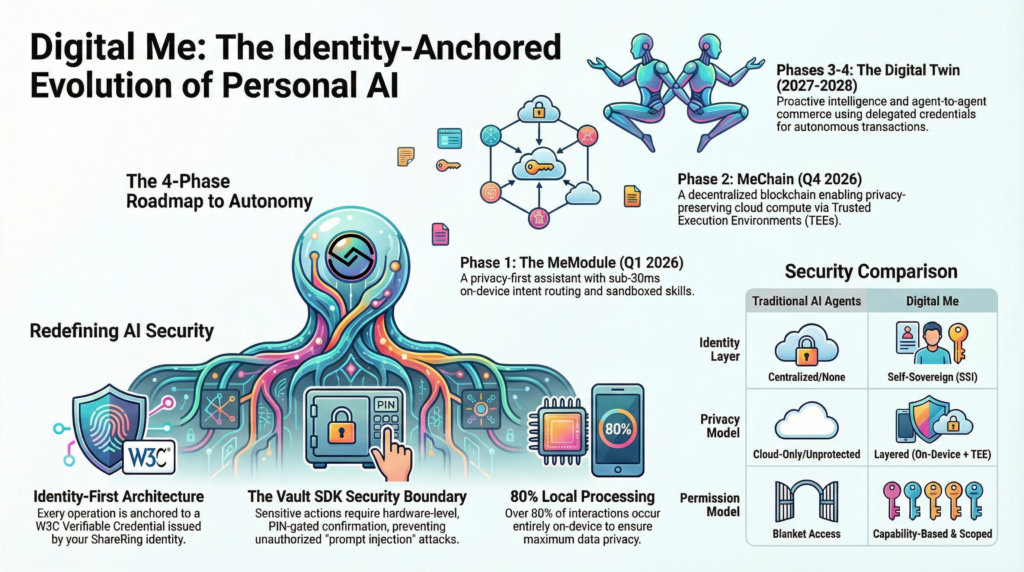
On the R&D front, our focus has extended beyond immediate market needs to the emerging world of AI-driven services and agents. We are increasingly concerned that many current AI models require users to sacrifice privacy in exchange for utility.
Our upcoming Smart Digital Me work outlines how privacy-preserving AI interfaces can operate using verified attributes, local inference, and user-controlled data. This includes concepts such as AI agents that can perform actions, including payments and verification, without ever accessing raw personal information.
We are already deploying on-device AI models to assist with tasks such as passport data extraction, fraud monitoring, and document verification, ensuring that Digital Me creation remains secure, human-verified, and privacy-preserving.
Looking ahead to 2026
If 2025 was about building foundations, 2026 is about execution and scale.
We anticipate a meaningful increase in digital identity verification transactions as pilots convert into production, new ShareRing Link workflows go live, and partners embed our SDKs into their platforms. A detailed roadmap and commercial objectives will be shared in January 2026, with a strong focus on sales, partnerships, and transaction growth.
As we move into this next phase, my communication will reflect delivered outcomes rather than intent. While innovation and vision remain core to ShareRing, my role as CEO is to ensure execution, commercial discipline, and measurable progress – and to communicate when there is meaningful evidence or updates to report.The regulatory environment continues to tighten. We believe this works in ShareRing’s favour. The need for compliant, privacy-preserving digital identity infrastructure is no longer theoretical. It is immediate.
Thank you for your continued support and engagement. We look forward to sharing the next phase of the journey with you.
Ryan Bessemer
CEO, ShareRing